








The Council of State Governments Justice Center (CSG Justice Center), the Urban Institute, and the U.S. Department of Justice, Bureau of Justice Assistance (BJA) are excited to announce the expansion of three new focus areas on the What Works in Reentry Clearinghouse (Clearinghouse) website—Substance Abuse, Education, and Family programs. To assist users in navigating the complexity of reentry research, as well as get acquainted with the new sections, the Urban Institute and the CSG Justice Center will conduct a training webinar.
-
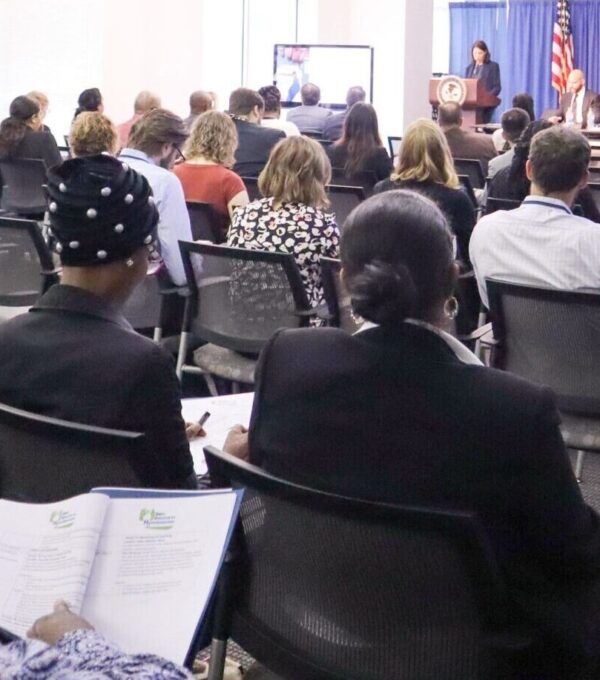
2013 JMHCP National Training and Technical Assistance Event
The CSG Justice Center, with support from the Bureau of Justice Assistance (BJA), convened more than 300 practitioners, researchers, and public officials for the Justice and Mental Health Collaboration (JMHCP) Program National Training and Technical Assistance Event, from [...] -
Criminal Justice/Mental Health Learning Sites
Since 2006, the CSG Justice Center to identify and highlight agencies from across the country with comprehensive and successful criminal justice/mental health programs that are willing [...] -
Adults with Behavioral Health Needs under Correctional Supervision
A New Collaborative Framework For Reducing Recidivism and Promoting Behavioral Health provided an overview of the report, “Adults with Behavioral Health Needs under Correctional Supervision". -
Technical Assistance (TA) to JMHCP Grantees
Since the release of its landmark Consensus Project Report in 2002, the Justice Center has provided on- and off-site technical assistance to states and localities working to ensure better public health and public safety outcomes for people with mental illnesses [...] -
Behavioral Health Framework
On September 27, 2012, the CSG Justice Center released Adults with Behavioral Health Needs under Correctional Supervision: A Shared Framework for Reducing Recidivism and Promoting Recovery.
2013 JMHCP National Training and Technical Assistance Event
Announcements
International Community Corrections Association’s Second Annual Conference in the “What Matters” Series: “One Criminal Justice System with Many Decision Makers: Working Toward A Shared Vision”
The conference will be divided into two tracks: public policy and operational policy. The public policy track will focus on defining what the criminal justice system intends to achieve and why those measureable outcomes are desired. The operational policy track will focus on how evidence-based practices increase the likelihood of improving public safety.
2013 National Alliance on Mental Health (NAMI) National Convention
On June 27-30, the City of San Antonio will host the 2013 National Alliance on Mental Illness (NAMI) National Convention, which will bring together nearly 2,000 attendees to discuss mental health issues, network, and gain inspiration. There are over 75 [...]
Webinars
How Organizations Implement and Sustain Evidence-Based Practices: Strategies, Tips, and Tools
This webinar provides an overview of “learning organizations” and presents examples of organizations within the criminal justice community as well as in other related fields to illustrate specific evidence-based strategies and practices that improve outcomes. Among the specific organizational aspects discussed are: staff recruitment, selection, training and assessment, organizational leadership and communication, best practice sharing, and quality assurance initiatives.
Use of Incentives and Sanctions to Promote Compliance with Supervision Conditions during Reentry: An Implementation Strategy
Hosted by the National Reentry Resource Center This webinar focussed on the use of incentives and sanctions with individuals under community supervision, particularly those returning to their communities from prison. It included an overview of current practices, policy, and research [...]
NRRC Webinar Innovations in Substance Abuse Treatment
Presenters review how adopting a “continuing care model” to treat substance use disorders can improve outcomes for individuals who are justice involved. Presenters also provide an overview of medications for the treatment of alcohol and opioid addiction, including how specific [...]
Creating a Strong Foundation for Effective Connections to Community Substance Abuse Treatment
This webinar was the first in a webinar series titled Best Practices for Engaging and Retaining Formerly Incarcerated Individuals in Community Substance Abuse Treatment. The webinar discussed how jurisdictions can create strong foundations for effective connections to community treatment through a [...]
Work Release Centers, Day Reporting Centers, and Halfway Houses: What Impact do They Have on Public Safety
This webinar will provide a general overview of work release centers, day reporting centers, and halfway houses. The presenter will discuss the specific target groups for which these sanctions are designed and how various jurisdictions identify and assign offenders to [...]
Mental Health Courts Research Roundup: Applying Research to Practice
This webinar, held on March 26th, 2013, provided an overview of emerging research about mental health courts and discussed its implications for mental health court practitioners and policymakers. During the webinar, mental health court researchers shared their findings and facilitated [...]
Effective Case Planning Strategies
Case plans provide a structured approach that helps supervising officers and probationers/parolees negotiate daily activities and achieve central reentry objectives. Effective case plans are dynamic instruments that organize a parolee or probationer’s behavioral expectations and are adapted according to his [...]
Recidivism Reduction Checklists: A Resource for State Corrections Agencies
Three checklists will be introduced during the webinar, each tailored to distinct audiences: Executive and Legislative Policymakers State Corrections Administrators State Reentry Coordinators During this invitation-only event, a distinguished panel of state corrections directors, policy staff, and state reentry coordinators [...]
Responding to the Second Chance Act Adult Grant Program
On January 22, 2013, the U.S. Department of Justice’s Bureau of Justice Assistance released the fiscal year 2013 solicitation for the Second Chance Act Adult Mentoring and Transitional Services for Successful Reentry Program. Nonprofit organizations and federally recognized Indian tribes [...]
Justice and Mental Health Collaboration Program Applicant
On January 24, 2013, the Department of Justice’s Bureau of Justice Assistance (BJA) released Justice and Mental Health Collaboration Program (JMHCP) grant applications. On February 19, 2013, the Council of State Governments Justice Center (CSG Justice Center) hosted a webinar [...]
Publications
Family Comes First: A Workbook to Transform the Justice System by Partnering with Families
This workbook, from the Campaign for Youth Justice, provides a comprehensive analysis of current family engagement and family partnership practices in juvenile justice systems across the country.
Promoting Recovery and Independence for Older Adolescents and Youth Adults Who Experience Serious Mental Health Challenges
This report, from the Substance Abuse and Mental Health Services Administration (SAMHSA), demonstrates that older adolescents and young adults who participate in SAMHSA-supported treatment programs report lower levels of substance use disorders than those who do not participate in SAMHSA-supported treatment programs.
Six Steps to Improve Your Drug Court Outcomes for Adults with Co-Occurring Disorders
This fact sheet, recently released by SAMHSA’s GAINS Center and the National Drug Court Institute, presents six steps to help drug court practitioners better serve persons with co-occurring mental illnesses and substance use disorders.
Implications of The Affordable Care Act on People Involved with the Criminal Justice System
Individuals involved with the criminal justice system face high rates of communicable and chronic diseases, mental illness, and substance use disorders. However, criminal justice practitioners often have difficulty connecting this largely low-income and uninsured population to the health services they [...]
The Northwestern Juvenile Project: Overview
This bulletin is the first in the U.S. Department of Justice’s Office of Juvenile Justice and Delinquency Prevention Beyond Detention Series. It presents an overview of the Northwestern Juvenile Project, the first large-scale longitudinal study of drug, alcohol, and psychiatric [...]
The 2013-2014 Budget: Obtaining Federal Funds for Inmate Medical Care – A Status Report
Since 1997, federal policy has made it possible to draw down federal Medicaid reimbursement for off-site inpatient health care services for eligible state prison inmates. Most recently, the Patient Protection and Affordable Care Act and the associated Low-Income Health Program [...]
Presumptive Eligibility: New Options in 2014
Successfully connecting millions of Americans to health coverage starting in October 2013 will require many different outreach and enrollment strategies. Hospitals and other human services providers will play a critical role in enrolling the uninsured, and beginning in 2014, they will [...]
Adults with Behavioral Health Needs under Correctional Supervision: A Shared Framework for Reducing Recidivism and Promoting Recovery
On September 27, 2012, the CSG Justice Center released Adults with Behavioral Health Needs under Correctional Supervision: A Shared Framework for Reducing Recidivism and Promoting Recovery. The report is written for policymakers, administrators, and service providers committed to improving outcomes for the [...]
A Checklist for Implementing Evidence-Based Practices and Programs for Justice-Involved Adults with Behavioral Health Disorders
The Substance Abuse and Mental Health Services Administration’s GAINS Center for Behavioral Health and Justice Transformation and the Council of State Governments Justice Center have prepared this easy-to-use checklist to help behavioral health agencies assess their utilization of evidence-based practices associated with positive public safety and public health outcomes.
The Affordable Care Act and Criminal Justice: Intersections and Implications
Various provisions of the Affordable Care Act—including the expansion of Medicaid, investments to be made in health information technology, establishment of health insurance exchanges, and minimum essential coverage—have direct and indirect implications for criminal justice. Success in implementing the Affordable [...]
Recent headlines
Incarcerating the mentally ill doesn’t help them, and it’s expensive
The News Tribune By Steve Maynard Repeat jail inmate Phillip Essary said he was winning the battle to stay sober and cope with his mental illness. Three days a week, two hours each day, he attended outpatient group sessions and [...]
Mental health care system needs overhaul
Journal Sentinel The way Milwaukee County provides care for those with mental illnesses is exactly backward of how it should be done. Instead of identifying symptoms early and providing necessary help through community services, the current system essentially waits until [...]
Group helps law enforcement keep repeat offenders out of jail
KOAT-TV ALBUQUERQUE, N.M. - A community-based program in Albuquerque is helping authorities keep repeat offenders out of jail. Officials at the Metropolitan Detention Center began taking hundreds of inmates to other facilities because the jail is already overcrowded. Officials said the [...]
Madison County sets up new court to handle cases involving military veterans
AL.com By Brian Lawson HUNTSVILLE, Alabama — Madison County Circuit Judge Ruth Ann Hall and the Madison County District Attorney’s Office today announced the creation of a new Veterans Court. The court is designed to handle cases involving veterans charged [...]
Federal prosecutors, Portland attorneys unable to reach agreement with police union on Police Bureau reforms
The Oregonian By Maxine Bernstein Federal prosecutors and city attorneys have reached an impasse with the Portland police union on reforms that should be made by the police bureau to address a scathing federal inquiry that found officers use excessive [...]
Mental Health Court in the Tri-Cities
KENNEWICK, Wash. — It’s supposed to help prisoners and save you money at the same time — Mental Health Court. It could be the newest program coming to the Tri-Cities. Thursday night in Kennewick, a group of individuals who work [...]
Brain injuries plague city jail inmates
The New York World By Maura R. O’Connor Health officials have discovered a disturbing trend among adolescents incarcerated at Rikers Island — an extremely high prevalence of traumatic brain injuries. In Department of Health and Mental Hygiene (DOHMH) study conducted [...]
Feds: Pa. Prison Misused Solitary Confinement
The Associated Press HARRISBURG, Pa. (AP) — A federal civil rights investigation has concluded that a state prison in western Pennsylvania kept inmates with serious mental illness in solitary confinement for months or even years at a time. The State [...]
Cheshire County makes strides with a new drug court
The Sentinel Source The recent effort to start a felony-level drug court in Cheshire County is a reflection of growing emphasis nationwide on rehabilitating criminals. With emerging information showing these specialized courts contribute to safer communities while saving taxpayer dollars, [...]
DOJ recounts ‘disturbing’ abuse of mentally ill at Pa. prison
The Hill By Megan R. Wilson A Pennsylvania state prison imposed violated the Constitution and imposed “cruel and unusual punishments” on prisoners with mental illnesses and intellectual disabilities, according to a Justice Department document released Friday. In a 39-page letter [...]