









12 Counties to Pilot New Approach for Behavioral Health Interventions in Justice Systems
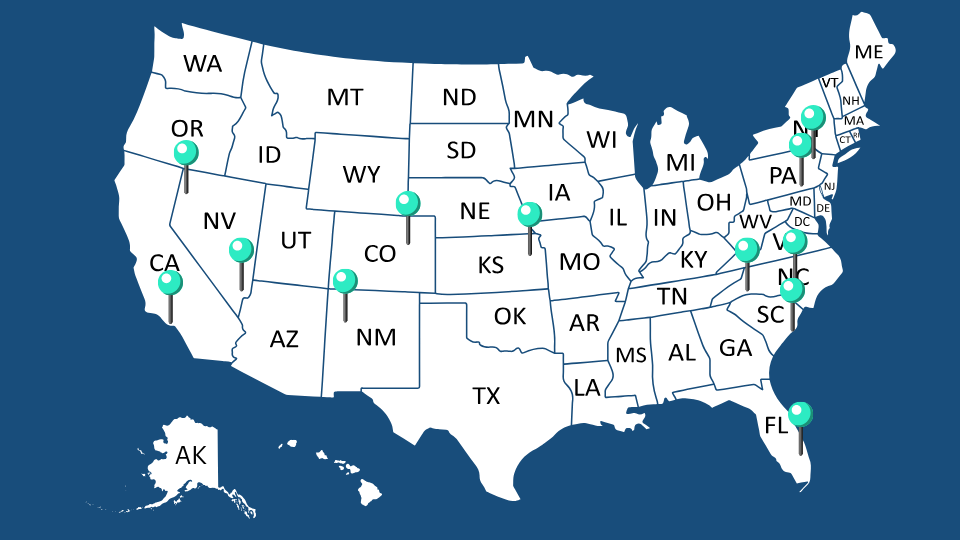
Counties selected for the pilot program
After reviewing a highly competitive applicant pool of nearly 50 counties, The Council of State Governments (CSG) Justice Center selected 12 counties to receive free, hands-on support as they implement behavioral health and legal interventions in their communities. Aiming to end the cycle of incarceration for people with untreated behavioral health needs, leaders in these counties will work directly with our staff to identify evidence-informed, post-booking strategies tailored to their local needs.
With funding from Arnold Ventures, the CSG Justice Center will work with the following counties to improve how their courts, jails, and community providers handle cases involving defendants with behavioral health needs:
- California: Santa Barbara County
- Colorado: Adams County
- Florida: Palm Beach County
- Kansas: Shawnee County
- New Mexico: Bernalillo County
- Nevada: Clark County and Washoe County
- North Carolina: Mecklenburg County and Wake County
- Pennsylvania: Cumberland County and Northampton County
- South Carolina: Horry County
These counties face common challenges that the pilot is designed to help diagnose and address:
- Competency evaluation and restoration delays that leave people stuck waiting in jail for services they can’t access fast enough
- Continuity of care, reentry, and housing gaps that can lead to hospitalization and homelessness after incarceration
- Data sharing and cross-system coordination breakdowns that keep courts, jails, and behavioral health providers from working off the same information
- Screening and early identification gaps at booking—when early intervention matters most
- Jail population growth and legislative/system strain that’s outpacing what local systems were built to handle
“This pilot gives counties something they rarely get: the time, expertise, and flexibility to build an intervention that actually fits their local system, rather than adopting a one-size-fits-all model,” said Alison Martin, CSG Justice Center policy director. “There’s no common playbook right now for who gets what interventions, even as people with behavioral health needs continue to cycle through the justice system. By the end of 2027, I hope to see these counties not just implementing evidence-informed interventions but building the data infrastructure to prove what’s working and creating a roadmap that counties across the country can follow.”
Through our Counties Aligning Health & Safety initiative, each county will receive free, hands-on technical assistance from our national policy experts, including access to a locally tailored decision-making tool that matches the needs of their target population to evidence-informed interventions. Counties will also join virtual peer learning sessions and connect with a research partner to strengthen their implementation plan and position them for future evaluation.
The pilot will run from September 2026 through December 2027, giving counties over a year of direct support to identify and implement interventions that make every dollar count.
Follow along as these counties move through planning and implementation, and learn how the post-booking framework can work for your county.
ABOUT THE AUTHOR


Applications are due Friday, July 31, 2026.
Read More