








Self-Assessment for Employment-Focused Reentry Programs
Measuring Fidelity to the Integrated Reentry and Employment Strategies (IRES) Framework
This self-assessment from the National Reentry Resource Center helps programs gauge their capacity to provide integrated reentry and employment interventions, including work readiness, to people with varying risks and needs. The tool helps reentry practitioners identify opportunities to build the capacity of their programming and services, which, in turn, can better prepare participants for employment and decrease their likelihood of returning to incarceration.
Finding employment is a critical part of successful reentry for the millions of people returning to communities after incarceration, but it’s not the only part. Appropriately addressing criminogenic risk and needs as well as the soft and hard skills necessary for the workplace are also key in reducing recidivism and improving long-term job retention in this population. Employment-focused reentry programs are often uniquely positioned to administer these services.
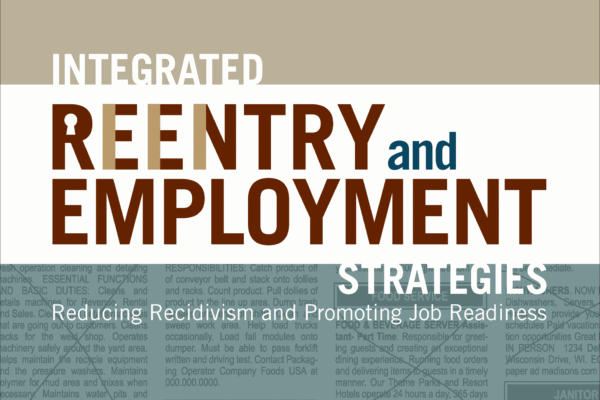
The self-assessment should be used in conjunction with the Integrated Reentry and Employment Strategies: Reducing Recidivism and Promoting Job Readiness (IRES) white paper, a resource released in 2013 that helps policymakers, practitioners, and system administrators ensure resources are being used effectively to improve employment outcomes for people who have been incarcerated or are on probation or parole.

"It is the humane, person-centered approach that supports and stabilizes individuals, their families, and their communities."
Read More
The Judge Stephen S. Goss Memorial Award for Leadership has expanded to include Lifetime Achievement Awards and, in…
Read More
On October 9, 2025, the Senate passed the Second Chance Reauthorization Act of 2025 (S. 1843), which would…
Read More
Local Criminal Justice System Innovations in Mental Health Services: Q&A with CSG Justice Center Advisory Board Member Dr. Doreen Williams
"It is the humane, person-centered approach that supports and stabilizes individuals, their families, and their communities."
Read More
2025 Nominations Now Open for Judges and Psychiatrists Improving Lives and Behavioral Health
The Judge Stephen S. Goss Memorial Award for Leadership has expanded to include Lifetime Achievement Awards and, in 2024, the first-ever Team Collaboration Award.
Read More
Senate Passes Second Chance Reauthorization Act of 2025
On October 9, 2025, the Senate passed the Second Chance Reauthorization Act of 2025 (S. 1843), which would continue critical recidivism-reduction and reentry services nationwide.
Read More CSG Justice Center Launches First-of-Its-Kind Statewide Crisis Intervention Teams (CIT) Technical Assistance Center
The CSG Justice Center has partnered with the Pennsylvania Commission on Crime and Delinquency and CIT International to launch a first-of-its-kind statewide Technical Assistance (TA) Center.
Read More How Kentucky’s “Seth’s Law” Reduces Barriers to Care for Competency to Stand Trial and Guardianship
Read More
How Kentucky’s “Seth’s Law” Reduces Barriers to Care for Competency to Stand Trial and Guardianship
Read More
 2025 in Review: Justice Data and Solutions for State and Local Leaders Amid Federal Change
Our mission hasn’t changed; it’s become more essential. The following 2025 accomplishments are a testament to that enduring focus.
Read More