







50 State Teams Gather to Develop Plans for Improving Youth Outcomes in Each State Juvenile Justice System
AUSTIN, TX—On the heels of new data showing massive reductions in the number of youth incarcerated, legislators, judges, juvenile justice administrators and other representatives from all 50 states met to tackle the next big challenge: making sure supervision and services provided in the correctional facilities and in the community reduce the likelihood youth will be rearrested and end up in the adult criminal justice system.
“The recently released figures describing the plunging decline in incarcerated youth are stunning: Nearly every state in the U.S. has reduced by more than half the number of youth in correctional facilities. We’ve achieved those declines while juvenile arrests are hitting historic lows,” said Michael Lawlor, undersecretary of Criminal Policy and Planning for the state of Connecticut, which has seen the largest percentage reduction of all states. “That’s an accomplishment that deserves to be celebrated.”
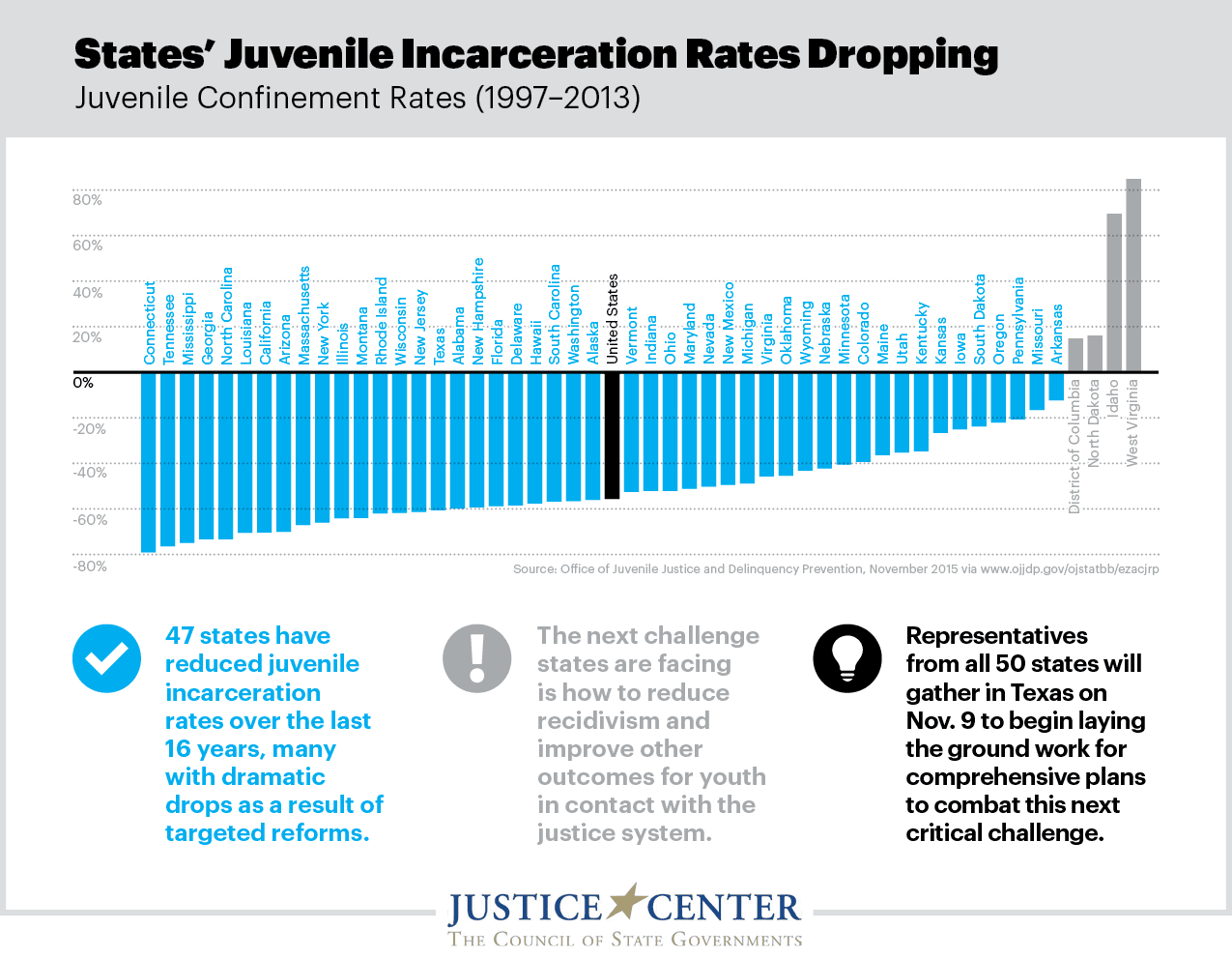
According to new numbers from the Office of Juvenile Justice and Delinquency Prevention (OJJDP), states’ juvenile incarceration rates have plummeted by 55 percent overall from 1997 to 2013. But there’s been less progress ensuring youth released from facilities or under community supervision succeed by staying crime free, achieving academically and getting jobs. Rearrest rates have commonly reached as high as 80 percent within three years of release from a facility, and rates for youth on community supervision are often not much better.
State teams, which comprised of lawmakers, juvenile justice officials, and judicial leaders, are convened for a two-day, “Improving Outcomes for Youth in the Juvenile Justice System: A 50-State Forum,” to build on their recent successes and to take aim at positioning youth for success later in life.
The forum, organized by The Council of State Governments (CSG) Justice Center with funding from the John D. and Catherine T. MacAthur Foundation and OJJDP, was held in Austin, TX, where state officials met earlier this year to review the results of a study that asked an important question: How are kids faring closer to home, as opposed to being incarcerated in state secure facilities?
“The data coming out of Texas showed us, for the first time, how much better kids do closer to home,” said Susan Burke, Utah’s Director of Juvenile Justice Services. “It also showed us that additional investment in probation and treatment alone doesn’t translate into reduced recidivism among youth under community supervision. This forum is so important because it focuses policymakers on what’s next: making sure the services and supports we provide youth in the community are grounded in the latest research. ”
At the forum, participants were encouraged to charge a group of state and local leaders with using checklists provided by the CSG Justice Center to assess whether current policies and practices match the latest research on “what works.”
“We hope that each team will leave this forum having established the ground work for a comprehensive plan that they continue to build on at home,” said Laurie Garduque, director of justice reform at the MacArthur Foundation. “We’ve had unmistakable success lowering youth incarceration rates in the US. At the same time, we must set our sights even higher: Lowering rearrest rates and improving the future outcomes of youth in contact with the juvenile justice children is the next frontier for this field.”
OJJDP Administrator Robert L. Listenbee also pledged the federal government’s support to states developing these comprehensive plans, announcing a new competitive grant program that draws on Second Chance Act funding.
New York Assemblyman Jeffrion Aubry also emphasized that keeping a young person out of prison and making sure he or she isn’t rearrested should not be the only benchmark for success. “How are we making sure they get an education?” he said. “How are we ensuring they’re on a path to a successful career? Our responsibility isn’t just to keep them out of the criminal justice system, but to help this generation of young people be successful.”
View more from the event, including team photos.
With about 300 people in attendance, state teams reviewed practical, user-friendly summaries of what the research shows to be effective strategies to reduce recidivism and improve other youth outcomes. Policymakers heard how states across the country are tracking outcome data and using this data to guide policy and funding decisions. The CSG Justice Center also released new materials Monday to help aid forum discussion:
- Reducing Recidivism and Improving Other Outcomes for Young Adults in the Juvenile and Adult Criminal Justice Systems is designed to help state and local officials better support young adults in the justice system. It identifies these young adults’ distinct needs, summaries the limited research available on what works to address these needs, and provides recommendations for steps that policymakers, juvenile and adult criminal justice agency leaders, researchers, and the field can take to improve outcomes.
- The infographics series, Improving Outcomes for Youth, detail three critical challenges faced by states to improve outcomes for youth, identify the key questions that policymakers should ask, and offer strategies for protecting public safety and using resources more efficiently.
The Judge Stephen S. Goss Memorial Award for Leadership has expanded to include Lifetime Achievement Awards and, in…
Read More
On October 9, 2025, the Senate passed the Second Chance Reauthorization Act of 2025 (S. 1843), which would…
Read More
The CSG Justice Center has partnered with the Pennsylvania Commission on Crime and Delinquency and CIT International to…
Read More
2025 Nominations Now Open for Judges and Psychiatrists Improving Lives and Behavioral Health
The Judge Stephen S. Goss Memorial Award for Leadership has expanded to…
Read More
Senate Passes Second Chance Reauthorization Act of 2025
On October 9, 2025, the Senate passed the Second Chance Reauthorization Act…
Read More
CSG Justice Center Launches First-of-Its-Kind Statewide Crisis Intervention Teams (CIT) Technical Assistance Center
The CSG Justice Center has partnered with the Pennsylvania Commission on Crime…
Read More How Kentucky’s “Seth’s Law” Reduces Barriers to Care for Competency to Stand Trial and Guardianship
Read More
How Kentucky’s “Seth’s Law” Reduces Barriers to Care for Competency to Stand Trial and Guardianship
Read More
 2025 in Review: Justice Data and Solutions for State and Local Leaders Amid Federal Change
Our mission hasn’t changed; it’s become more essential. The following 2025 accomplishments…
Read More 25 Reentry Wins in 2025: How States Are Removing Barriers to Reentry Success
From new laws and reentry councils to increased funding and lowered barriers,…
Read More