









We at The Council of State Governments (CSG) Justice Center are saddened to learn of the passing Dr. Ed Latessa, director of the University of Cincinnati Corrections Institute. His tireless efforts to develop, refine, and advocate for effective strategies to reduce recidivism informed much of our work.
Dr. Latessa was a giant in his field, who devoted his life and career to guide scores of justice professionals to a better understanding of how the justice system could be an effective vehicle for rehabilitation and second chances. He routinely traveled around the country, delivering engaging and compelling presentations about current research and best practices, advising state officials, advocates, and practitioners, and serving as a keynote speaker at numerous high-profile conferences.
“With his focus on how to help correctional programs be more effective, Dr. Latessa led the field forward through his vision, research, presentations, mentorship, humor, and friendship,” said Marshall Clement, CSG Justice Center Deputy Director. “He was always focused on figuring out what worked, helping everyone understand why, and developing tools for the field to apply the research. His contributions have helped change countless lives and made our communities safer.”
Dr. Latessa worked closely with the CSG Justice Center’s Justice Reinvestment teams to help distill research for legislative audiences and to assist with program implementation. He presented at many of the CSG Justice Center’s national 50-state conferences focused on reducing adult and juvenile recidivism, reforming community supervision, and increasing public safety. But his legacy isn’t just about his work. He generously gave of his time to mentor justice professionals early in their careers, and he was always available for a call, email, or chat.
“I had the good fortune to work with Ed on three major projects over the past decade,” said David D’Amora, CSG Justice Center Senior Policy Advisor. “His contributions improved every one of them and his constant advice to us was to not make things too complicated. He knew we had to be able to make those not involved in the field understand the issues clearly if we want to achieve lasting change in criminal justice.”
Our thoughts are with Dr. Latessa’s family and friends. He will be sorely missed by all who knew him and had the privilege of working with him.
Photo credit: Steinsky

The CSG Justice Center has partnered with the Pennsylvania Commission on Crime and Delinquency and CIT International to…
Read More
Our mission hasn’t changed; it’s become more essential. The following 2025 accomplishments are a testament to that enduring…
Read More
CSG Justice Center Launches First-of-Its-Kind Statewide Crisis Intervention Teams (CIT) Technical Assistance Center
The CSG Justice Center has partnered with the Pennsylvania Commission on Crime and Delinquency and CIT International to launch a first-of-its-kind statewide Technical Assistance (TA) Center.
Read More How Kentucky’s “Seth’s Law” Reduces Barriers to Care for Competency to Stand Trial and Guardianship
Read More
2025 in Review: Justice Data and Solutions for State and Local Leaders Amid Federal Change
How Kentucky’s “Seth’s Law” Reduces Barriers to Care for Competency to Stand Trial and Guardianship
Read More
2025 in Review: Justice Data and Solutions for State and Local Leaders Amid Federal Change
Our mission hasn’t changed; it’s become more essential. The following 2025 accomplishments are a testament to that enduring focus.
Read More 25 Reentry Wins in 2025: How States Are Removing Barriers to Reentry Success
From new laws and reentry councils to increased funding and lowered barriers, these wins highlight collaboration, creativity, and innovation across our Reentry 2030 network.
Read More
Job Training in Prison: Reentry 2030 States Explore Innovative Models and Partnerships
State leaders gathered for the fourth session of the Reentry 2030 Workforce Development Peer Learning Cohort.
Read More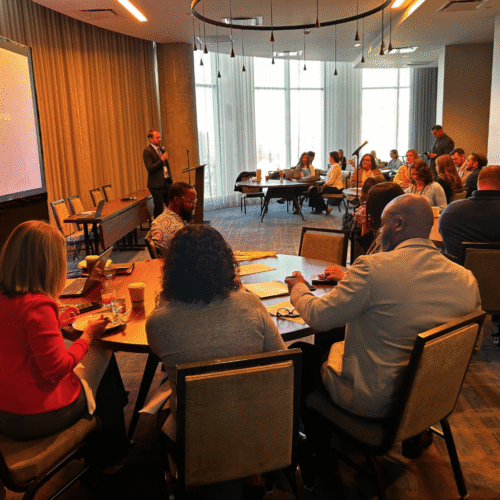 Getting the Right Response When Every Crisis Is Different: 4 States Share Lessons on Building Coordinated Crisis Systems
New Jersey, Utah, Virginia, and Washington discuss their different "Aligning Health and Safety" approaches and some of the challenges they’ve experienced.
Read More