








Minnesota Governor’s Council on Justice Reinvestment Reviews Proposed Policy Options
On January 27, 2022, the Minnesota Governor’s Council on Justice Reinvestment met for the third time to discuss proposed policy options focused on improving the effectiveness and equity of the state’s supervision system. The options are based on findings from a comprehensive quantitative analysis and supervision assessment conducted by the CSG Justice Center as part of the state’s Justice Reinvestment Initiative (JRI) and were developed by the Delivery System Standards and Funding Policy Working Group with assistance from the CSG Justice Center.
The policy options address the following objectives:
- Ensuring counties are equitably funded and positioned to comprehensively implement evidence-based supervision
- Ensuring effectiveness and equity across the state’s different probation
- Holding people on probation consistently accountable
- Prioritizing quality assurance of supervision practices
- Reducing racial disparities across the supervision systems
- Improving access to behavioral health care in the community for people under community supervision
- Ensuring that victims of crime are meaningfully engaged in restorative supervision practices
- Measuring outcomes
The council also heard testimony from members of the public including people who have been involved in the criminal justice system, victims of crime, or who have worked within the justice system.
The council reported the findings of their comprehensive examination of the state’s supervision system to the governor on February 1, 2022. The group will continue to explore policy recommendations and deliver their final recommendations by the end of February to inform action during the 2022 legislative session.
Both the council—a bipartisan, interbranch committee—and the working group—a committee established to update the state’s supervision funding formula—are overseeing JRI in the state, which is funded by the U.S. DOJ’s Office of Justice Programs, Bureau of Justice Assistance and The Pew Charitable Trusts.
©Ben Krut
This project was supported by Grant No. 2019-ZB-BX-K002 awarded by the Bureau of Justice Assistance. The Bureau of Justice Assistance is a component of the Department of Justice’s Office of Justice Programs, which also includes the Bureau of Justice Statistics, the National Institute of Justice, the Office of Juvenile Justice and Delinquency Prevention, the Office for Victims of Crime, and the SMART Office. Points of view or opinions in this document are those of the author and do not necessarily represent the official position or policies of the U.S. Department of Justice.

Our mission hasn’t changed; it’s become more essential. The following 2025 accomplishments are a testament to that enduring…
Read More
From new laws and reentry councils to increased funding and lowered barriers, these wins highlight collaboration, creativity, and…
Read More How Kentucky’s “Seth’s Law” Reduces Barriers to Care for Competency to Stand Trial and Guardianship
Read More
2025 in Review: Justice Data and Solutions for State and Local Leaders Amid Federal Change
How Kentucky’s “Seth’s Law” Reduces Barriers to Care for Competency to Stand Trial and Guardianship
Read More
2025 in Review: Justice Data and Solutions for State and Local Leaders Amid Federal Change
Our mission hasn’t changed; it’s become more essential. The following 2025 accomplishments are a testament to that enduring focus.
Read More
25 Reentry Wins in 2025: How States Are Removing Barriers to Reentry Success
From new laws and reentry councils to increased funding and lowered barriers, these wins highlight collaboration, creativity, and innovation across our Reentry 2030 network.
Read More
Job Training in Prison: Reentry 2030 States Explore Innovative Models and Partnerships
State leaders gathered for the fourth session of the Reentry 2030 Workforce Development Peer Learning Cohort.
Read More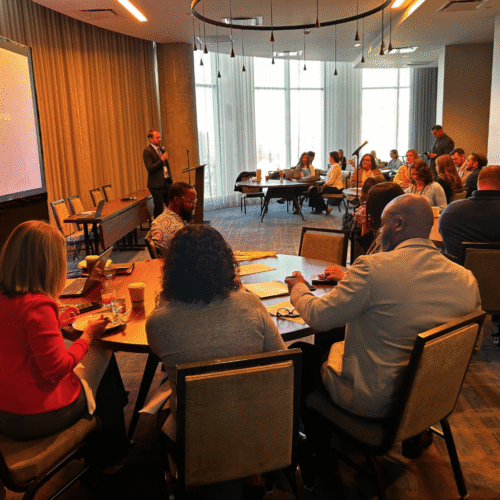 Getting the Right Response When Every Crisis Is Different: 4 States Share Lessons on Building Coordinated Crisis Systems
New Jersey, Utah, Virginia, and Washington discuss their different "Aligning Health and Safety" approaches and some of the challenges they’ve experienced.
Read More DOJ and DOL Announce $155.5M in Federal Funding Opportunities for Reentry, Community Supervision, Behavioral Health, Youth, and Incarcerated Parents
Application deadlines range from March 19–April 6, 2026.
Read More