







Bipartisan Group of 66 Lawmakers Support Continued Funding for the Justice and Mental Health Collaboration Program
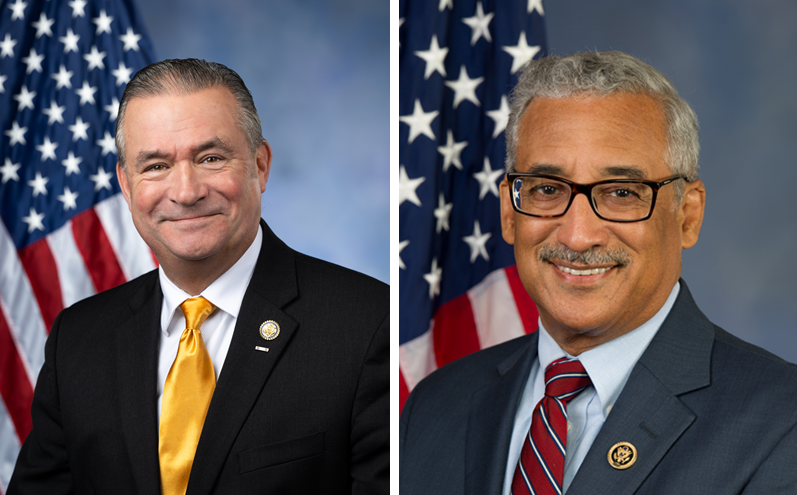
Left to right: Congressmen Don Bacon (R-NE) and Bobby Scott (D-VA)
A bipartisan group of 66 lawmakers, led by Congressmen Don Bacon (R-NE) and Bobby Scott (D-VA), wrote a letter calling for continued funding for the Justice and Mental Health Collaboration Program (JMHCP) in the Fiscal Year 2026 Commerce, Justice, Science, and Related Agencies appropriations bill. JMHCP supports initiatives for people with mental illnesses and co-occurring mental health and substance use disorders who interact with the justice system.
Originally enacted in 2004, JMHCP was reauthorized by Congress in 2008, 2016, and 2022 with broad bipartisan support. Since inception, JMHCP has funded more than 795 grants across 50 states, the District of Columbia, and several U.S. territories.
The program provides grants to state and local governments to pilot and launch innovative justice and mental health initiatives—such as crisis intervention teams, mental health courts, prosecutor-led diversion, police training, co-response teams with clinicians, jail treatment services, and crisis receiving centers—that can be sustained beyond the initial period and integrated into ongoing local practices and funding streams
Since 2004, 250 law enforcement agencies have used JMHCP funding to jumpstart co-responder models that reduce encounters with people who have mental illnesses and connect them to services. Similarly, more than 290 agencies have leveraged JMHCP funding to create new court-based responses, such as mental health courts and specialty dockets, to treat people with behavioral health needs and connect them to treatment. These initiatives are scaling the use of evidence-based practices that reduce recidivism, enhance public safety, lower public safety costs, and improve outcomes for individuals with mental illnesses or substance use disorders by connecting them to needed care.
The letter from Representatives Bacon, Scott, and colleagues highlights that “people with mental illnesses who are involved with the criminal justice system tend to stay in jail longer than people without mental illnesses. For example, people with mental illnesses spend twice as long in jail awaiting trial than people without mental illnesses. Those experiencing mental illnesses are also more likely to return to jail. Jails spend two to three times more on incarcerating people with mental illnesses, and yet this investment has not translated into increased public safety or advances in longer-term recovery.”
The letter goes on to note that “Congress can take a leadership role to address this challenge by continuing its bipartisan support for funding to bring together mental health providers, criminal justice agencies, law enforcement, consumers, and family members to better identify and address the needs of people with mental health conditions involved with the criminal justice system. This collaboration helps direct people to appropriate care, which saves lives, reduces recidivism, long-term incarceration, and other criminal justice costs.”

The CSG Justice Center has partnered with the Pennsylvania Commission on Crime and Delinquency and CIT International to…
Read More
Our mission hasn’t changed; it’s become more essential. The following 2025 accomplishments are a testament to that enduring…
Read More
CSG Justice Center Launches First-of-Its-Kind Statewide Crisis Intervention Teams (CIT) Technical Assistance Center
The CSG Justice Center has partnered with the Pennsylvania Commission on Crime…
Read More How Kentucky’s “Seth’s Law” Reduces Barriers to Care for Competency to Stand Trial and Guardianship
Read More
2025 in Review: Justice Data and Solutions for State and Local Leaders Amid Federal Change
How Kentucky’s “Seth’s Law” Reduces Barriers to Care for Competency to Stand Trial and Guardianship
Read More
2025 in Review: Justice Data and Solutions for State and Local Leaders Amid Federal Change
Our mission hasn’t changed; it’s become more essential. The following 2025 accomplishments…
Read More 25 Reentry Wins in 2025: How States Are Removing Barriers to Reentry Success
From new laws and reentry councils to increased funding and lowered barriers,…
Read More
Job Training in Prison: Reentry 2030 States Explore Innovative Models and Partnerships
State leaders gathered for the fourth session of the Reentry 2030 Workforce…
Read More Getting the Right Response When Every Crisis Is Different: 4 States Share Lessons on Building Coordinated Crisis Systems
New Jersey, Utah, Virginia, and Washington discuss their different "Aligning Health and Safety"…
Read More