









2025 in Review: Justice Data and Solutions for State and Local Leaders Amid Federal Change
In the face of federal funding cuts, the CSG Justice Center responded with resilience and a commitment to our core mission: to be the trusted partner that state and local leaders rely on when developing solutions for complex justice challenges.
Focusing on our foundational strengths—trusted data, cross-system collaboration, and practical strategies—we’ve continued to ensure that state and local leaders have the tools they need to build safer, healthier communities and better justice and behavioral health systems. Our mission hasn’t changed; it’s become more essential. The following 2025 accomplishments are a testament to that enduring focus.
Driving Evidence-Based Policy with 50-State Justice Data
Effective policy begins with accurate information people can depend on, and throughout 2025, we equipped state leaders with the trusted insights needed to navigate their most pressing justice challenges.
- Justice Data Snapshots: To ensure leaders have reliable information for sound policy decisions, we synthesized state-by-state data on crime, corrections, behavioral health, and more from over 70 trusted sources into an interactive tool. The snapshots empower leaders to benchmark progress, identify opportunities, and build data-driven policies tailored to states’ needs.
- The Impact of Supervision Violations: Our research revealed that states spent over $10 billion incarcerating nearly 200,000 people for supervision violations in 2023. By illuminating the immense cost of this practice, we’re equipping leaders with the data to pursue smarter, more cost-effective alternatives to incarceration.
- The Power of Parole Boards: Our first-of-its-kind report, Overlooked: How Parole Boards Shape Lives and Systems, pulled back the curtain on the powerful but opaque boards that control the fate of more than 210,000 people in prison. The report outlines the transparency needed for states to ensure these critical bodies are fair and effective.
Reducing Crime & Strengthening Crisis Response
We helped states and localities move beyond simply reacting to crime to building proactive, evidence-based systems that prevent and solve crime, support victims, and strengthen community trust.
- Focusing on Solving Violent Crime: In a time of high public anxiety, we drew attention to a key concern: More than half of violent crimes go unsolved every year. We analyzed the latest FBI crime data on solve rates and developed practical guides that help state policymakers shift their focus from simply reacting to crime to reducing and solving it.
- Helping State Leaders Build Stronger, More Cost-Effective Justice Systems: Through our Justice Reinvestment approach, we worked with leaders to understand the drivers of incarceration and jail pressure and to strengthen sentencing and release decision-making. We also launched efforts to strengthen investigative capacity and community coordination, ensuring that victims, service providers, and public safety partners can address crime effectively at the earliest points of justice involvement. In West Virginia, we’re helping state and county leaders examine what’s driving regional jail overcrowding and the financial and operational pressures stemming from pretrial detention. By putting trusted data directly into policymakers’ hands and helping them align resources where they have the greatest impact, we’re ensuring states are ready to rapidly deploy upcoming federal investments and turn priorities into measurable public safety improvements.
-
Improving First Response: As communities work to enhance public safety, we published actionable recommendations from our National Expanding First Response Commission to help state leaders build and scale smarter crisis response systems, ensuring that people experiencing behavioral health crises receive the first response that best meets their needs. We’re also partnering with four states (New Jersey, Utah, Virginia, and Washington) through our Aligning Health and Safety project to help them integrate 988/911 responses, build effective crisis infrastructure, and work with community-based organizations and mental health professionals to advance alternative crisis response efforts.
-
Preventing Youth Justice Involvement: The most effective way to improve public safety is to prevent behaviors and address risk factors that lead to justice involvement in the first place. Through our Collaborating for Youth and Public Safety Initiative (CYPSI), we’re actively partnering with six states to develop action plans that connect youth with community-based services, not courtrooms. Our commitment to prevention also includes elevating key research, such as the Youth Protective Factors Study, which provides critical insights into the strengths and supports that help young people thrive.
Redefining Reentry & Removing Post-Incarceration Barriers to Success
With recidivism costing states billions of dollars annually, state leaders are demanding more effective reentry strategies. Our Reentry 2030 initiative supports states in their commitment to dramatically improve life after incarceration and reduce recidivism.
- Bolstering Reform Efforts: In May, the Second Chance Reauthorization Act of 2025 was introduced in the Senate and the U.S. House of Representatives. We led efforts to support passage of the bill, coordinating a national working group of organizations that elevated the importance of the act and reentry resources to Congress. The bipartisan act would ensure the continuation of critical reentry services for people returning from incarceration including housing, education, substance use disorder treatment, and job training.
- State Commitments: This year, Arizona joined the Reentry 2030 initiative, pledging to increase workforce certifications, employment, and pre-release health care access for people after release from jail or prison.
- Improving Employment Outcomes: Leaders from Arizona and six other states (Alabama, California, Nebraska, New York, North Carolina, and Washington) convened multiple times as part of the Reentry 2030 Workforce Development Peer Learning Cohort to explore how they can increase employment after incarceration.
- Moving Beyond Recidivism: We released new strategies for states to measure reentry success that include critical indicators like stable housing, employment, and health. By moving beyond recidivism and tracking what really matters for successful reentry, our guide empowers state leaders to reduce recidivism, design smarter policies, and build safer communities.
Strengthening Cross-System Behavioral Health Responses
Improving health outcomes is fundamental to improving public safety. This year, we spotlighted new pathways to connect people with community-based care and celebrated a decade of success in helping state and local leaders confront the behavioral health crisis in jails and communities.
- Seizing a Historic Health Care Opportunity: 19 states have federal approval to use Medicaid reentry waivers for up to 5 years to reimburse critical reentry supports such as prescriptions, medication-assisted treatment, and case management for people preparing to leave prison and jail. This is the first time Medicaid has been able to cover these services pre-release, creating a once-in-a-generation opportunity to reshape reentry. Our first-of-its-kind analysis showed this policy shift stands to benefit nearly 2 million people annually. We are now poised to provide targeted support to help state and local leaders accelerate implementation.
- Marking a Decade of Local Stepping Up Impact: In partnership with the National Association of Counties and the American Psychiatric Association Foundation, we celebrated the 10th anniversary of the Stepping Up initiative. This groundbreaking, data-driven work has united nearly 600 counties in 45 states around the common goals of connecting people to behavioral health care, reducing the time people with mental health and/or substance use conditions spend in jail, and cutting the cost of incarceration.
Join the Work Ahead
The work highlighted here is just a snapshot of our ongoing commitment. From helping leaders reduce violent crime to looking beyond recidivism to measure successful reentry, our mission to help state and local leaders improve the justice and behavioral health systems has never been more urgent.
We are continuing to provide data-driven solutions for the most complex justice challenges facing states and communities today. We do this by combining three powerful ingredients: trusted data, practical strategies, and deep cross-systems collaboration.
With a track record of bipartisan support, a presence in all 50 states, and a proven ability to translate priorities into progress, we remain uniquely positioned to bridge the gap between research and real-world results to make communities safer and healthier for all.
Are you a state leader ready to tackle your next justice challenge? Reach out to our staff who are working to:
- Develop and assess reentry or juvenile justice strategies:
Contact Susan Gottesfeld at sgottesfeld@csg.org - Redesign how behavioral health and the justice system work together:
Contact Hallie Fader-Towe at hfader@csg.org - Use data to improve justice systems and reduce crime:
Contact Grace Beil Call at gcall@csg.org

The CSG Justice Center has partnered with the Pennsylvania Commission on Crime and Delinquency and CIT International to…
Read More
From new laws and reentry councils to increased funding and lowered barriers, these wins highlight collaboration, creativity, and…
Read More
CSG Justice Center Launches First-of-Its-Kind Statewide Crisis Intervention Teams (CIT) Technical Assistance Center
The CSG Justice Center has partnered with the Pennsylvania Commission on Crime…
Read More How Kentucky’s “Seth’s Law” Reduces Barriers to Care for Competency to Stand Trial and Guardianship
Read More
25 Reentry Wins in 2025: How States Are Removing Barriers to Reentry Success
How Kentucky’s “Seth’s Law” Reduces Barriers to Care for Competency to Stand Trial and Guardianship
Read More
25 Reentry Wins in 2025: How States Are Removing Barriers to Reentry Success
From new laws and reentry councils to increased funding and lowered barriers,…
Read More
Job Training in Prison: Reentry 2030 States Explore Innovative Models and Partnerships
State leaders gathered for the fourth session of the Reentry 2030 Workforce…
Read More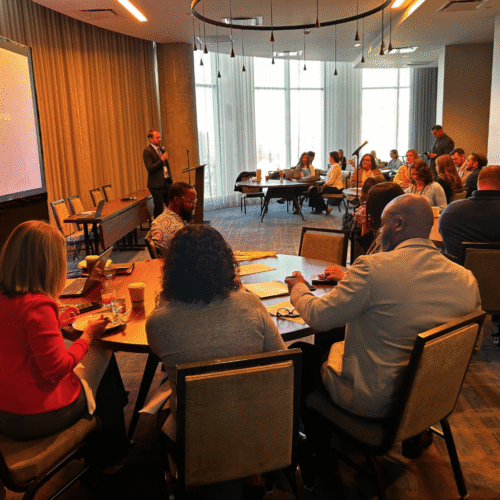 Getting the Right Response When Every Crisis Is Different: 4 States Share Lessons on Building Coordinated Crisis Systems
New Jersey, Utah, Virginia, and Washington discuss their different "Aligning Health and Safety"…
Read More DOJ and DOL Announce $155.5M in Federal Funding Opportunities for Reentry, Community Supervision, Behavioral Health, Youth, and Incarcerated Parents
Application deadlines range from March 19–April 6, 2026.
Read More