









A Ten-Step Guide to Transforming Probation Departments to Reduce Recidivism
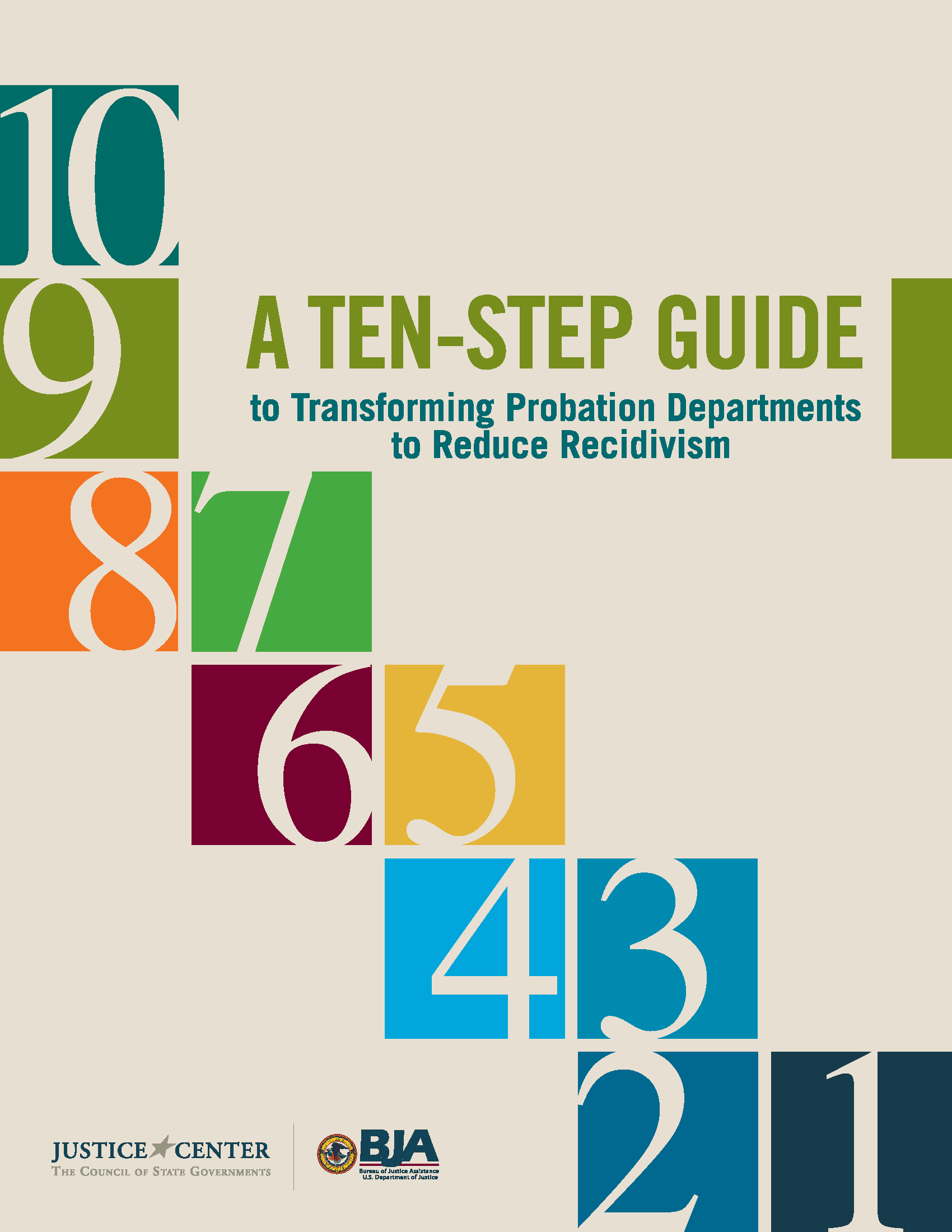
This publication from The Council of State Governments Justice Center outlines four core practices probation leaders and policymakers should follow when working to reduce recidivism and improve public safety in their communities, which are: (1) effectively assessing peoples' criminogenic risk and needs, (2) employing smart, tailored supervision strategies, (3) using incentives and graduated sanctions, and (4) implementing performance-driven personnel management practices that promote and reward recidivism reduction.
A Ten-Step Guide to Transforming Probation Departments to Reduce Recidivism also describes how officials can engage key stakeholders, evaluate agency policies, and develop a strategic plan for implementing reform; provides recommendations for redesigning departmental policies and practices; and includes steps for making a department transformation permanent. Included are numerous examples of how these steps were used in the Travis County, Texas, probation department, which saw felony probation revocations decline by 20 percent and one-year rearrest rates fall by 17 percent after implementing practices outlined in the guide.
Online Course
In 2019, the American Probation and Parole Association released an online course designed in partnership with the National Reentry Resource Center. Based on A Ten-Step Guide to Transforming Probation Departments to Reduce Recidivism, the course provides a ten-step action plan to help a probation department visualize transformation of its practices from beginning to end, and to align it with the four practices of recidivism reduction.

Our mission hasn’t changed; it’s become more essential. The following 2025 accomplishments are a testament to that enduring…
Read More
From new laws and reentry councils to increased funding and lowered barriers, these wins highlight collaboration, creativity, and…
Read More How Kentucky’s “Seth’s Law” Reduces Barriers to Care for Competency to Stand Trial and Guardianship
Read More
2025 in Review: Justice Data and Solutions for State and Local Leaders Amid Federal Change
Our mission hasn’t changed; it’s become more essential. The following 2025 accomplishments are a testament to that enduring focus.
Read More
25 Reentry Wins in 2025: How States Are Removing Barriers to Reentry Success
From new laws and reentry councils to increased funding and lowered barriers, these wins highlight collaboration, creativity, and innovation across our Reentry 2030 network.
Read More
Job Training in Prison: Reentry 2030 States Explore Innovative Models and Partnerships
State leaders gathered for the fourth session of the Reentry 2030 Workforce Development Peer Learning Cohort.
Read More Getting the Right Response When Every Crisis Is Different: 4 States Share Lessons on Building Coordinated Crisis Systems
New Jersey, Utah, Virginia, and Washington discuss their different "Aligning Health and Safety" approaches and some of the challenges they’ve experienced.
Read More DOJ and DOL Announce $155.5M in Federal Funding Opportunities for Reentry, Community Supervision, Behavioral Health, Youth, and Incarcerated Parents
Application deadlines range from March 19–April 6, 2026.
Read More