








The Impact of Probation and Parole Populations on Arrest in Four California Cities
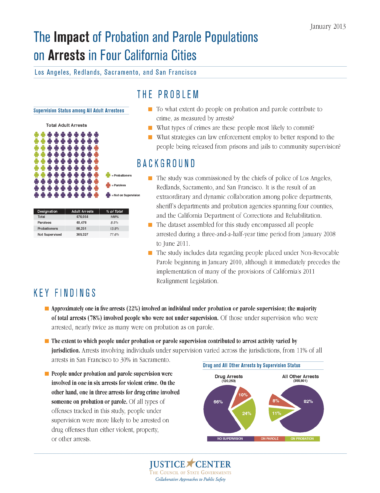
On January 22, 2013 the Council of State Governments Justice Center released The Impact of Probation and Parole Populations on Arrests in Four California Cities. The unprecedented study answers one question that to date has been a matter of speculation among law enforcement and corrections officials everywhere: to what extent do people on probation and parole contribute to crime, as measured by arrests?
The chiefs of the Los Angeles, Redlands, Sacramento, and San Francisco Police Departments commissioned the analysis in 2010. Collecting and analyzing the data required an extraordinary effort spanning 11 independent agencies, including four local police jurisdictions, county law enforcement and probation agencies, two county sheriffs’ departments and the California Department of Corrections and Rehabilitation (CDCR). Researchers at the CSG Justice Center collected and matched more than 2.5 million arrest, parole, and probation records generated between January 1, 2008 and June 11, 2011.
Among the most notable findings in these four jurisdictions:
- The majority of all adult felony and misdemeanor arrests were of people who were not currently under supervision. People under supervision accounted for only 22 percent of total arrests.
- Whereas people under probation and parole supervision accounted for one out of every six arrests for violent crimes, they accounted for one out of every three drug arrests.
- During a 3.5 year period in which total arrests fell by 18 percent, the number of arrests involving individuals under parole supervision declined by 61 percent and by 26 percent for individuals under probation supervision.

The CSG Justice Center has partnered with the Pennsylvania Commission on Crime and Delinquency and CIT International to…
Read More
Our mission hasn’t changed; it’s become more essential. The following 2025 accomplishments are a testament to that enduring…
Read More
CSG Justice Center Launches First-of-Its-Kind Statewide Crisis Intervention Teams (CIT) Technical Assistance Center
The CSG Justice Center has partnered with the Pennsylvania Commission on Crime and Delinquency and CIT International to launch a first-of-its-kind statewide Technical Assistance (TA) Center.
Read More How Kentucky’s “Seth’s Law” Reduces Barriers to Care for Competency to Stand Trial and Guardianship
Read More
2025 in Review: Justice Data and Solutions for State and Local Leaders Amid Federal Change
How Kentucky’s “Seth’s Law” Reduces Barriers to Care for Competency to Stand Trial and Guardianship
Read More
2025 in Review: Justice Data and Solutions for State and Local Leaders Amid Federal Change
Our mission hasn’t changed; it’s become more essential. The following 2025 accomplishments are a testament to that enduring focus.
Read More 25 Reentry Wins in 2025: How States Are Removing Barriers to Reentry Success
From new laws and reentry councils to increased funding and lowered barriers, these wins highlight collaboration, creativity, and innovation across our Reentry 2030 network.
Read More
Job Training in Prison: Reentry 2030 States Explore Innovative Models and Partnerships
State leaders gathered for the fourth session of the Reentry 2030 Workforce Development Peer Learning Cohort.
Read More Getting the Right Response When Every Crisis Is Different: 4 States Share Lessons on Building Coordinated Crisis Systems
New Jersey, Utah, Virginia, and Washington discuss their different "Aligning Health and Safety" approaches and some of the challenges they’ve experienced.
Read More