








Opioid Addiction and the Criminal Justice System
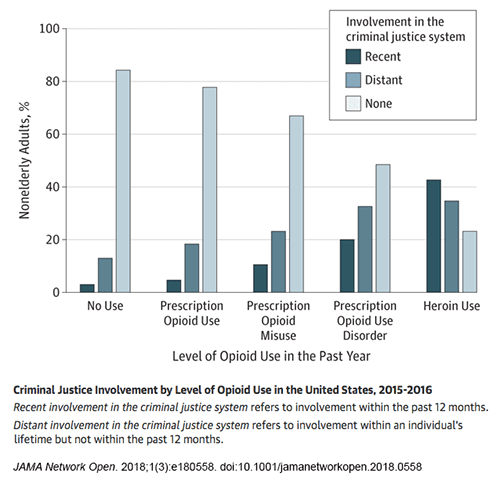 Each year, the increasing number of people who have opioid addictions impacts communities across the United States. In 2016, substance overdoses (fueled by opioid addictions) surpassed death by car accidents and guns as the leading cause of death for Americans under 50 years old, and in 2017, 134 people died each day from opioid overdose. Opioid use has a significant correlation to criminal justice involvement, and the consequences of opioid addictions can impact everyone from the people seeking recovery to law enforcement first responders, correctional facility staff, and reentry professionals. Despite efforts to promote recovery and reentry, when people who have opioid addictions are released from prison or jail, they often face a significantly higher risk of overdose and overdose-related death than people who were never incarcerated. In North Carolina alone, the risk of overdose death from opioids was 40 times higher for people released from incarceration in state facilities than it was for the general population in the state.
The resources below are designed to assist correctional agencies, community-based treatment providers, probation and parole agencies, and other service providers in better responding to people who have opioid addictions who are in the criminal justice system.
Webinars

This webinar includes information on planning and coordination, behavioral health treatment, cognitive…
Read More
This webinar is designed for Justice and Mental Health Collaboration Program and…
Read More
This webinar focusses on best practices for screening and assessment of people…
Read MoreYou might also be interested in

Apply Now for Resident Analyst Program to Increase Data Analysis Capacity at Departments of Corrections
Corrections leaders balance the complex priorities of maintaining public safety, operating secure facilities, providing needed care and services…
Read More
Five New CSG Justice Center Board Members Look to Strengthen Communities and Improve Public Safety
The CSG Justice Center is pleased to announce 5 new members of its advisory board. Hailing from states…
Read More
Removing Barriers to Successful Reentry: Q&A with New CSG Justice Center Advisory Board Member Dr. Ronald F. Day
The CSG Justice Center Advisory Board establishes the policy and project priorities of the organization. The board features…
Read More
Apply Now for Resident Analyst Program to Increase Data Analysis Capacity at Departments of Corrections
Corrections leaders balance the complex priorities of maintaining public safety, operating secure facilities, providing needed care and services to the incarcerated population, and coordinating with other agencies.
Read More
Five New CSG Justice Center Board Members Look to Strengthen Communities and Improve Public Safety
The CSG Justice Center is pleased to announce 5 new members of its advisory board. Hailing from states across the country and representing multiple professions, they are all eager to join the 17 current members in establishing the policy and project priorities for the organization.
Read More
Removing Barriers to Successful Reentry: Q&A with New CSG Justice Center Advisory Board Member Dr. Ronald F. Day
The CSG Justice Center Advisory Board establishes the policy and project priorities of the organization. The board features a cross-section of leaders who shape criminal justice policy in various parts of the country.
Read More Transforming Lives with Access to Needed Mental Health Care: Q&A with New CSG Justice Center Advisory Board Member Dr. Courtney Harvey
The CSG Justice Center Advisory Board establishes the policy and project priorities of the organization. The board features a cross-section of leaders who shape criminal justice policy in various parts of the country.
Read More Six States Commit to Improving Statewide Strategies to Address Youth Crime, Violence and Behavioral Health
The Council of State Governments (CSG) Justice Center has launched the Collaborating for Youth and Public Safety Initiative (CYPSI) in partnership with six states: California, New Mexico, New York, Ohio, Oklahoma, and Rhode Island. The initiative will help states develop, fund, and effectively implement a research-based service continuum to improve public safety and behavioral health, education, and other outcomes for youth.
Read More Statement by The Council of State Governments Justice Center on Termination of Public Safety Grants
Washington, DC – Termination of bipartisan Department of Justice grants appropriated by Congress last week drew the attention of leaders and organizations across the country.
Read More