









Ensuring Timely Access to Medicaid and SSI/SSDI for People with Mental Illness Released from Prison: Four Case Studies
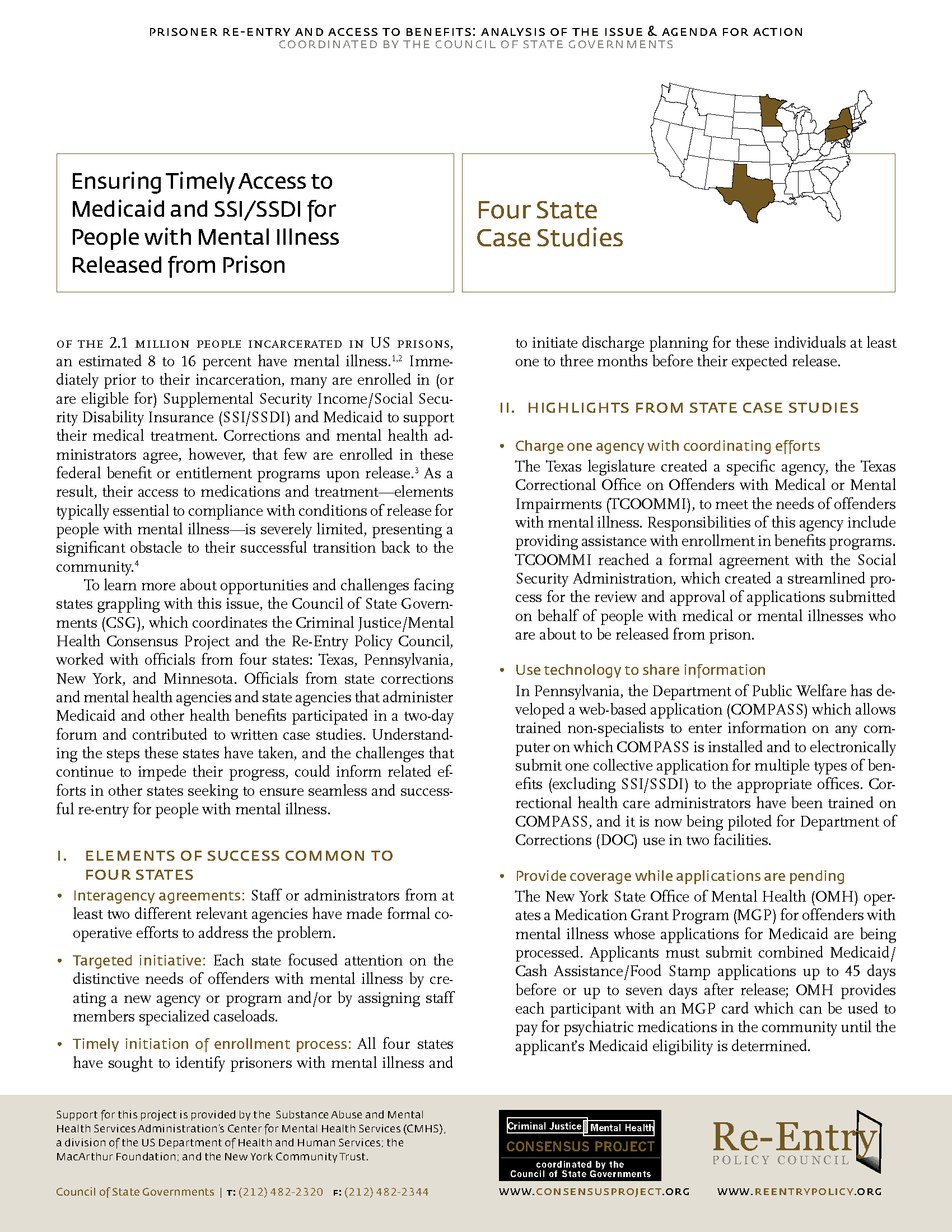
This fact sheet from the Council of State Governments Criminal Justice/Mental Health Consensus Project, in conjunction with the Re-Entry Policy Council, provides an analysis of case studies from four states, identifying common elements of success, highlights from each state, and continuing challenges to state efforts.
Among people in prison with mental illnesses, many are enrolled in (or are eligible for) Supplemental Security Income/Social Security Disability Insurance (SSI/SSDI) and Medicaid to support their medical treatment prior to incarceration, but few are enrolled in these federal benefit or entitlement programs upon release. As a result, their access to medications and treatment—elements typically essential to compliance with conditions of release for people with mental illness—is severely limited, presenting a significant obstacle to their successful transition back to the community.

On October 9, 2025, the Senate passed the Second Chance Reauthorization Act of 2025 (S. 1843), which would…
Read More
The CSG Justice Center has partnered with the Pennsylvania Commission on Crime and Delinquency and CIT International to…
Read More
Senate Passes Second Chance Reauthorization Act of 2025
On October 9, 2025, the Senate passed the Second Chance Reauthorization Act of 2025 (S. 1843), which would continue critical recidivism-reduction and reentry services nationwide.
Read More
CSG Justice Center Launches First-of-Its-Kind Statewide Crisis Intervention Teams (CIT) Technical Assistance Center
The CSG Justice Center has partnered with the Pennsylvania Commission on Crime and Delinquency and CIT International to launch a first-of-its-kind statewide Technical Assistance (TA) Center.
Read More How Kentucky’s “Seth’s Law” Reduces Barriers to Care for Competency to Stand Trial and Guardianship
Read More
How Kentucky’s “Seth’s Law” Reduces Barriers to Care for Competency to Stand Trial and Guardianship
Read More
 2025 in Review: Justice Data and Solutions for State and Local Leaders Amid Federal Change
Our mission hasn’t changed; it’s become more essential. The following 2025 accomplishments are a testament to that enduring focus.
Read More 25 Reentry Wins in 2025: How States Are Removing Barriers to Reentry Success
From new laws and reentry councils to increased funding and lowered barriers, these wins highlight collaboration, creativity, and innovation across our Reentry 2030 network.
Read More
Job Training in Prison: Reentry 2030 States Explore Innovative Models and Partnerships
State leaders gathered for the fourth session of the Reentry 2030 Workforce Development Peer Learning Cohort.
Read More