








Research and Resource Companion for High-Risk Youth and Challenging Cases Bench Cards
Table of Contents

Photos Credit: Zachary Caraway/Pexels
Table of Contents
Overview and How to Use this Guide
Judges, policymakers, and communities are increasingly concerned about youth crime and violence. In response, some decision-makers are adopting sanctions-heavy approaches that are not shown to improve public safety. Judges play a critical role in identifying truly high-risk youth and applying timely, research-based dispositional decisions and interventions to reduce reoffending. They also need evidence-based strategies for cases when youth are struggling to comply with their probation conditions and/or make consistent treatment progress.
This research summary complements the “Judicial Decision-Making for High-Risk Youth” and “How Courts Can Best Support Post-Dispositional Success for Challenging Delinquency Cases” bench cards, offering a research “cheat sheet,” brief summaries with references, and additional resources to help judges and other court stakeholders apply proven practices, supported by training and implementation tools.
What Research Shows About Identifying Youth’s Risk to Public Safety and Assessing Case Progress
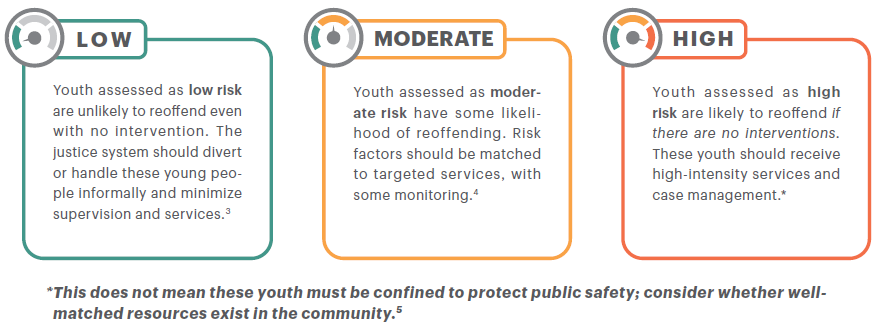
1. Risk predicts likelihood of reoffending, not the seriousness of the offense.
- The severity of a youth’s offense is not a strong indicator of the future likelihood of offending.1
- “High risk” means a youth is at high risk of committing another delinquent offense. Risk levels predict the likelihood of future offenses, not their severity. Youth may have a high risk to reoffend without a high risk to commit violent or serious offenses.2
2. Mental health is an important consideration but needs to be addressed appropriately.
- Youth who are at high risk to reoffend do not necessarily have mental health issues, and having serious mental health issues does not make youth high risk to reoffend.6 However, among youth in juvenile justice settings, those with mental health needs tend to have higher levels of risk factors than their peers.7
- Providing mental health treatment to youth with mental health needs does not lead to lower recidivism but is important for addressing their mental health issues and for ensuring they can fully participate in and benefit from risk-reduction services.8
- Treating risk factors and mental health issues results in the most significant recidivism reduction for high-risk youth with mental health needs.9
3. Protective factors are important responsivity factors.
- Protective factors increase the likelihood of success (reduce the risk of recidivism) especially in high-risk cases.10
- Protective factors can also be leveraged to increase successful completion of programming.11
- The protective factors with the most impact on reducing reoffending include self-control, self-efficacy, prosocial engagements (sense of purpose, school connectedness for younger youth), and social support from caregivers.12
4. Validated risk, strengths, and needs screening and assessment tools work; professional judgment alone isn’t reliable.
- Risk of reoffending is best measured through validated risk assessment tools, rather than professional judgment alone. They are also more equitable.13
- These assessments include static risk factors, unchangeable elements like a youth’s prior offenses, and dynamic risk factors, which are changeable.14 Dynamic risk factors include disruptive behavior problems (personality/behavior); substance misuse; family/lack of parental monitoring; negative peer influences; attitudes supporting crime; employment and education; and use of leisure time.15
- The most risk reduction occurs by targeting the following dynamic risk factors: disruptive behavior problems; family/lack of parental monitoring; negative peer influence; and attitudes supporting crime.16
- Mental health and trauma screening is also important for identifying youth with additional needs to effectively match them to appropriate services that complement risk-reduction services.17
5. High-risk youth frequently do not receive the appropriate service or the right “dosage” of those services.18
- Juvenile justice systems should reassess high-risk youth at key intervals and prioritize case planning based on a youth’s driving factors to ensure not only the right service but the right dosage and that those services are evidence based for this population and high quality.19
What Works (and What Doesn’t) to Reduce Risk of Reoffending and How to Respond When Things Aren’t Going Well
6. One-size-fits-all responses and services do not significantly reduce recidivism and can cause harm.20
- Adolescents are impulsive, risk-seeking, and don’t consider long-term consequences.21
- Probation conditions, such as daily school attendance, are static and absolute; adolescents are inconsistent, and their behavior improvements will not be linear.22
7. Surveillance by itself doesn’t help.
- High-risk youth should receive more intensive supervision and services, but supervision alone has little to no impact on reoffending, and intensive surveillance can increase recidivism and violations.23
8. Targeted services reduce recidivism.
- Services that target high-risk youth’s individual dynamic risk factors are most effective at reducing recidivism.24 Dispositional decisions for high-risk youth should reflect their individual risk of reoffending, protective factors and strengths,25 dynamic risk factors as measured by a validated risk assessment, and any mental health needs as measured by a validated mental health screening and assessment.
- Research has shown that services such as cognitive behavioral therapy, family therapy, and skill-building activities can reduce recidivism for high-risk youth26 by targeting the dynamic risk factors27 most strongly associated with serious offending.
- Key violence prevention and intervention strategies with promising evidence for reducing recidivism and violence among high-risk youth, when combined with risk-reduction services, include credible messengers, restorative justice,28 and violence interrupters.29
- Research shows that youth of color are less likely to be referred for treatment-oriented or strength-based services than their White peers.30
- Younger youth may require different recidivism-reduction strategies than youth ages 16 or 17.31
9. Extensive probation conditions don’t increase compliance or behavior change.32
- Traditional approaches to probation conditions don’t hold youth accountable or address the underlying causes of youth’s behavior. To improve public safety and reduce recidivism, conditions should be limited in number and written in developmentally appropriate language.33
- Research has shown a negative relationship between the number of conditions and successful compliance—adolescents in particular struggle to keep track of long lists of requirements.34
- Youth (and families) often don’t understand probation conditions and related court orders that are written using legalese, vague terms, and academic language.35
- Research has shown that youth of color are often subject to a greater number of conditions, as well as more punitive and less “positive” conditions than their White peers, such as increased drug testing requirements and decreased access to restorative justice opportunities.36
10. Timely, proportional, graduated incentive-based responses are more effective than punitive ones.
- When youth are struggling to meet the goals in their case plan, incentives, graduated responses, and restorative practices are more effective than punitive sanctions, including detention, probation extensions, fines and fees, or more restrictive probation conditions.37
11. Longer supervision does not lead to better outcomes.
- In most cases, extending time in placement beyond 6–9 months and on probation beyond 6–12 months does not reduce reoffending and often has diminishing returns and creates more potential for violations. 38
12. Placement should be rare.
- Research has consistently shown that, in most instances, placement is an ineffective public safety strategy—youth who are incarcerated are more likely to reoffend, commit felony offenses, and less likely to graduate from high school than similar peers who are served in the community.39
- Research also consistently shows a correlation between residential placement and greater likelihood of adult criminal justice system involvement,40 as well as a higher likelihood to reoffend than youth in community programs.41 There is also a much greater financial cost for out-of-home placements than community programs.42
- Even for high-risk youth, detention and post-dispositional placement should only be used when public safety is at imminent risk—as assessed by a validated risk/detention screening assessment—or youth have such intensive behavioral health needs that they require stabilization.43
- Institutional placement has diminishing returns for reduced risk and public safety after 6–9 months.44
- Research has shown that Black youth are three times more likely to be incarcerated in state custody for a technical violation than White youth.45
13. Youth need to be treated fairly.
- Adolescents are more likely to participate and buy into court, supervision, and service processes if they feel they have been treated fairly (procedural justice).46
- Treating youth (and families) fairly includes protecting due process rights, ensuring access to counsel throughout the case,47 and giving them the opportunity to shape supervision and service decisions.
- Research has shown that youth of color are often wrongly perceived as less remorseful and more individually culpable—as opposed to being influenced by external factors—than their White peers.48
14. Avoid transfer to adult court.
- Youth in the juvenile justice system are less likely to recidivate than youth transferred to adult court.49
- Research has shown that youth of color are more likely than White youth to be transferred to adult court for similar offenses.50 Black youth face an adultification bias in which they are viewed as older and more culpable than their White counterparts, resulting in disproportionately harsher outcomes, including a higher likelihood of interaction with adult criminal courts.51
- Youth in adult facilities experience higher levels of victimization than in juvenile facilities.52
Additional Resources and Support
Below are some of the top additional resources available on these topics.
- Breaking the Rules: Rethinking Condition Setting and Enforcement in Juvenile Probation (CSG Justice Center)
- Core Principles for Reducing Recidivism and Improving Other Outcomes for Youth in the Juvenile Justice System (CSG Justice Center)
- Desktop Guide to Good Juvenile Probation Practice (NCJJ and NCJFCJ)
- Enhanced Juvenile Justice Guidelines (NCJFCJ)
- Pathways to Desistance (National Institute of Justice)
- The Role of the Judge in Transforming Juvenile Probation (NCJFCJ)
- Youth Protective Factors Study (UMASS Chan Medical School)
- National Youth Screening and Assessment Partners
Additionally, judges should understand foundational research and best practices related to the following:
- Adolescent Development
- Risk-Needs-Responsivity (RNR)
- Validated Screening and Assessment Tools
- Youth Due Process Rights
- Effective Case Planning
- Programs and Services
- Youth and Family Engagement
- Racial and Ethnic Disparities
- Procedural Justice
Endnotes
1. Elizabeth Seigle, Nastassia Walsh, and Josh Weber, Core Principles for Reducing Recidivism and Improving Other Outcomes for Youth in the Juvenile Justice System (New York: The Council of State Governments Justice Center, 2014), https://csgjusticecenter.org/publications/juvenile-justice-white-paper/.
2. Ibid.
3. Ibid.
4. Ibid.
5. Ibid.
6. A. Guebert and M. E. Olver, “An Examination of Criminogenic Needs, Mental Health Concerns, and Recidivism in a Sample of Violent Young Offenders: Implications for Risk, Need, and Responsivity,” The International Journal of Forensic Mental Health 13, no. 4 (2014): 295–310, https://psycnet.apa.org/record/2014-45726-003; Sarah McCormick, Michele Peterson-Badall, and Tracy Skilling, “The Role of Mental Health and Specific Responsivity in Juvenile Justice Rehabilitation,” Law and Human Behavior 41, no. 1 (2016), https://www.researchgate.net/publication/311679402_The_ Role_of_Mental_Health_and_Specific_Responsivity_in_Juvenile_Justice_Rehabilitation; Carol Schubert, Edward Mulvey, and Cristie Glasheen, “Influence of Mental Health and Substance Use Problems and Criminogenic Risk on Outcomes in Serious Juvenile Offenders,” Journal of the American Academy of Child and Adolescent Psychiatry 50, no. 9 (2011): 925–937, https://pubmed.ncbi.nlm.nih.gov/21871374/; Jennifer Skeem, Henry Steadman, and Sarah Manchak, “Applicability of the Risk-Need-Responsivity Model to Persons With Mental Illness Involved in the Criminal Justice System,” Psychiatric Services 66, no. 9 (2015): 916–922, https://psychiatryonline.org/doi/pdf/10.1176/appi.ps.201400448.
7. Ibid.
8. Ibid.
9. Ibid.
10. Josh Weber et al., “Protective Factors and Strength-Based Services: Impacts on Long-Term Youth Reoffending” (Worcester, MA: UMass Chan Medical School, Department of Psychiatry, Law & Psychiatry Program, 2025), https://repository. escholarship.umassmed.edu/server/api/core/bitstreams/90bf0ac8-2349-417b-9bda-9e6704d3d4da/content.
11. Ibid.
12. Ibid.
13. Jodi Viljoen et al., “Impact of Risk Assessment Instruments on Rates of Pretrial Detention, Post-Conviction Placements, and Release: A Systematic Review and Meta-Analysis,” Law and Human Behavior 43, no. 5 (2019): 397–420, https:// psycnet.apa.org/fulltext/2019-46921-001.pdf; Spencer Lawson, Emma Narkewicz, and Gina Vincent, “Disparate Impact of Risk Assessment Instruments: A Systematic Review,” Law and Human Behavior 48, no. 5–6 (2024): 427–440, https:// pubmed.ncbi.nlm.nih.gov/39347719/.
14. Seigle, Walsh, and Weber, Core Principles.
15. Gina Vincent, Jennifer Skeem, and Josh Weber, Youth Reoffending: Prevalence and Predictive Risk Factors in Two States (Worcester, MA: UMass Chan Medical School, Department of Psychiatry, Law & Psychiatry Program, 2024), https:// escholarship.umassmed.edu/server/api/core/bitstreams/5bcb2dff-09ac-41e3-96e1-689ab3de8534/content.
16. Ibid.
17. Kathleen Skowyra et al., Mental Health Screening within Juvenile Justice: The Next Frontier (Delmar, NY: National Center for Mental Health and Juvenile Justice, 2006), https://modelsforchange.net/publications/198/Mental_Health_ Screening_within_Juvenile_Justice_The_Next_Frontier.pdf; Thomas Grisso, “Why We Need Mental Health Screening and Assessment in Juvenile Justice Programs,” in Mental Health Screening and Assessment in Juvenile Justice, eds. Thomas Grisso, Gina M. Vincent, and Daniel Seagrave (New York: Guilford Press, 2005); Edward P. Mulvey, “Risk Assessment in Juvenile Justice Policy and Practice,” in Juvenile Delinquency: Prevention, Assessment, and Intervention, eds. Kirk Heilbrun, Naomi E. Sevin Goldstein, and Richard E. Redding (Oxford, UK: Oxford University Press, 2005).
18. Jennifer Skeem, Gina Vincent, and Josh Weber, Risk-Based Services, Reoffending, and Rethinking Service Approaches for Justice-Involved Youth (Worcester, MA: UMass Chan Medical School, Department of Psychiatry, Law & Psychiatry Program, 2025), 3, https://repository.escholarship.umassmed.edu/server/api/core/bitstreams/343709a1-4e1c-4e91-8bef-3160bfee011f/content.
19. Ibid.
20. Seigle, Walsh, and Weber, Core Principles.
21. National Research Council, Reforming Juvenile Justice: A Developmental Approach (Washington, DC: The National Academies Press, 2013), https://doi.org/10.17226/14685.
22. Stephanie Shaw and Josh Weber, Breaking the Rules: Rethinking Condition Setting and Enforcement in Juvenile Probation (New York: The Council of State Governments Justice Center, 2022), https://projects.csgjusticecenter.org/ breaking-the-rules/wp-content/uploads/sites/5/2022/10/Breaking-the-Rules-Toolkit.pdf.
23. Seigle, Walsh, and Weber, Core Principles.
24. Ibid.
25. Weber et al., Protective Factors.
26. Seigle, Walsh, and Weber, Core Principles.
27. Vincent, Skeem, and Weber, Youth Reoffending.
28. Lawrence Sherman and Heather Strang, Restorative Justice: The Evidence (London: The Smith Institute, 2007), https://www.iirp.edu/images/pdf/RJ_full_report.pdf.
29. Josh Weber, Restorative Justice Practices and Credible Messengers: Promising, Innovative Approaches for Improving Outcomes for Youth in the Juvenile Justice System (New York: The Council of State Governments Justice Center, 2024) https://csgjusticecenter.org/publications/restorative-justice-practices-and-credible-messengers-promising-innovative-approaches-for-improving-outcomes-for-youth-in-the-juvenile-justice-system; See also Gina Vincent, “What works with youth? Effective use of science to assess risk, improve outcomes, and enhance public safety,” PowerPoint presentation, Courting Judicial Excellence Juvenile Justice Judicial Training Institute, Austin, Texas, August 20, 2025. Top-tier services that reduce violence among youth include cognitive behavioral therapy (CBT) and its variants, multisystemic therapy (MST), multidimensional family therapy (MDFT), and functional family therapy (FFT). Other services that have been evaluated and proven effective include high second-tier rating: “Parenting with Love and Limits,” “Big Brothers/Big Sisters of America,” dialectical behavior therapy (DBT); low second-tier rating: multidimensional treatment foster care, brief strategic family therapy, parent management training).
30. Elizabeth Spinney et al., “Racial Disparities in Referrals to Mental Health and Substance Abuse Services from the Juvenile Justice System: A Review of the Literature,” Journal of Crime and Justice 39, no. 1 (2017): 153–173; Margarita Alegria et al., “Disparities in Treatment for Substance Use Disorders and Co-occurring Disorders for Ethnic/Racial Minority Youth,” Journal of the American Academy of Child & Adolescent Psychiatry 50, no. 1 (2011): 22–31.
31. Skeem et al., Risk-Based Services, Reoffending, and Rethinking Service Approaches for Justice-Involved Youth.
32. Amanda NeMoyer et al., “Predictors of Juveniles’ Noncompliance with Probation Requirements,” Journal of Law and Human Behavior 38, no. 6 (2014): 580–591.
33. Shaw and Weber, Breaking the Rules.
34. Ibid.
35. Ibid.
36. Michael Leiber and Jennifer Peck, “Probation Violations and Juvenile Justice Decision Making: Implications for Blacks and Hispanics,” Youth Violence and Juvenile Justice 11 (2013): 60–78, doi:10.1177/1541204012447960.
37. Richard J. Bonnie et al., eds., Reforming Juvenile Justice: A Developmental Approach (Washington, DC: National Academies Press, 2013).
38. Allyson Dir et al., “The Point of Diminishing Returns in Juvenile Probation: Probation Requirements and Risk of Technical Probation Violations Among First-Time Probation-Involved Youth,” Psychology, Public Policy, and Law 72, no. 2 (2021): 283–291, https://pubmed.ncbi.nlm.nih.gov/34588760/.
39. Richard Mendel, “Why Youth Incarceration Fails: An Updated Review of the Evidence,” The Sentencing Project, March 1, 2023, accessed August 15, 2025, https://www.sentencingproject.org/reports/why-youth-incarceration-fails-an-updated-review-of-the-evidence/.
40. A. Aizer and J. J. Doyle, “Juvenile Incarceration, Human Capital, and Future Crime: Evidence from Randomly-Assigned Judges,” NBER WORKING PAPER SERIES (2013); E. Copeland et al., “Adult Criminal Outcomes of Juvenile Justice Involvement,” Psychological Medicine 53, no. 8, (2023): 3711–3718, https://doi.org/10.1017/S0033291722000393; A. B. Gilman, K. G. Hill, and J. D. Hawkins, “When Is a Youth’s Debt to Society Paid? Examining the Long-Term Consequences of Juvenile Incarceration for Adult Functioning,” Journal of Developmental and Life-Course Criminology 1, no. 1, (2015): 33–47, https://doi.org/10.1007/s40865-015-0002-5; Richard Mendel, “Why Youth Incarceration Fails: An Updated Review of the Evidence,” The Sentencing Project, March 1, 2023, accessed October 27, 2025, https://www.sentencingproject. org/reports/why-youth-incarceration-fails-an-updated-review-of-the-evidence/.
41. L. Pappas and A. L. Dent, The 40-year Debate: A Meta-Review on What Works for Juvenile Offenders. Journal of Experimental Criminology 19, no. 1, (2023): 1–30, https://doi.org/10.1007/s11292-021-09472-z; I. Park and C. J. Sullivan, “Youth in Adult and Juvenile Correctional Facilities: Comparison of Services and Behavioral Management,” Criminal Justice Policy Review 32, no. 9 (2021): 992–1017, https://doi.org/10.1177/08874034211014927 .
42. Justice Policy Institute, Sticker Shock 2020: The Cost of Youth Incarceration (Washington, DC: Justice Policy Institute, 2020), https://justicepolicy.org/wp-content/uploads/2022/02/Sticker_Shock_2020.pdf.
43. Edward P. Mulvey, Highlights from Pathways to Desistance: A Longitudinal Study of Serious Adolescent Offenders (Washington, DC: Office of Juvenile Justice and Delinquency Prevention, 2011), https://ojjdp.ojp.gov/library/publications/highlights-pathways-desistance-longitudinal-study-serious-adolescent-offenders.
44. E. P. Mulvey et al., “Longitudinal Offending Trajectories Among Serious Adolescent Offenders,” Development & Psychopathology 22 (2010): 453–475. Carcerative dispositions or sanctions increase risk of reoffense and should be reserved for cases with public safety
45. Office of Juvenile Justice and Delinquency Prevention, “Easy Access to the Census of Juveniles in Residential Placement” (Washington, DC: Office of Juvenile Justice and Delinquency Prevention, 2019), https://www.ojjdp.gov/ojstatbb/ezacjrp/.
46. Carol Schubert et al., “Perceptions of Institutional Experience and Community Outcomes for Serious Adolescent Offenders,” Criminal Justice and Behavior 39, no. 1 (2012): 71–93, https://journals.sagepub.com/doi/abs/10.1177/0093854811426710; Jeffrey A. Fagan and Tom R. Tyler, “Legal Socialization of Children and Adolescents,” Social Justice Research 18, no. 3 (2005): 217–241, https://link.springer.com/article/10.1007/s11211-005-6823-3.
47. See, e.g., “Honoring Gault: Ensuring Access to Counsel in Delinquency Proceedings,” https://www.ncjfcj.org/wp-content/ uploads/2021/03/Access-to-Counsel-Policy-Card-Final-8.18.16.pdf.
48. Laura Beckman and Nancy Rodriguez, “Race, Ethnicity, and Official Perceptions in the Juvenile Justice System: Extending the Role of Negative Attributional Stereotypes,” Criminal Justice and Behavior 48, 11 (2021): 1536–1556, doi:10.1177/00938548211004672; George Bridges and Sara Steen, “Racial Disparities in Official Assessments of Juvenile Offenders: Attributional Stereotypes as Mediating Mechanisms,” American Sociological Review 63, no. 4 (1998): 554–570; Susan Bandes, “Remorse and Criminal Justice,” Emotion Review 8, no. 1 (2016): 14–19, doi:10.1177/1754073915601222.
49. Centers for Disease Control and Prevention, Effects on Violence of Laws and Policies Facilitating the Transfer of Youth from the Juvenile to the Adult Justice System: A Report on Recommendations of the Task Force on Community Preventive Services (Atlanta: Centers for Disease Control and Prevention, MMWR 2007), 56 (No. RR-9), http://www.cdc. gov/mmwr/pdf/rr/rr5609.pdf.
50. Marcy Mistrett and Mariana Espinoza, Youth in Adult Courts, Jails, and Prisons (Washington, DC: The Sentencing Project, 2021), https://www.sentencingproject.org/app/uploads/2022/09/Youth-in-Adult-Courts-Jails-and-Prisons.pdf.
51. Phillip Atiba Goff et al., “The Essence of Innocence: Consequences of Dehumanizing Black Children,” Journal of Personality and Social Psychology 106, no. 4 (2014): 526–545, https://www.apa.org/pubs/journals/releases/psp-a0035663.pdf.
52. Mistrett and Espinoza, Youth in Adult Courts, Jails, and Prisons.
Want more information or support?
Please contact Christina Gilbert (cgilbert@csg.org) at The Council of State Governments Justice Center and Hunter Hurst (hhurst@ncjfcj.org) at the National Council of Juvenile and Family Court Judges.

This resource is supported by State Justice Institute Award #24P034. Points of view or opinions expressed are those of the report contributors and do not necessarily represent the official position or policies of the funder.

Corrections leaders balance the complex priorities of maintaining public safety, operating secure facilities, providing needed care and services…
Read More
The CSG Justice Center is pleased to announce 5 new members of its advisory board. Hailing from states…
Read More
The CSG Justice Center Advisory Board establishes the policy and project priorities of the organization. The board features…
Read More
Apply Now for Resident Analyst Program to Increase Data Analysis Capacity at Departments of Corrections
Corrections leaders balance the complex priorities of maintaining public safety, operating secure facilities, providing needed care and services to the incarcerated population, and coordinating with other agencies.
Read More
Five New CSG Justice Center Board Members Look to Strengthen Communities and Improve Public Safety
The CSG Justice Center is pleased to announce 5 new members of its advisory board. Hailing from states across the country and representing multiple professions, they are all eager to join the 17 current members in establishing the policy and project priorities for the organization.
Read More
Removing Barriers to Successful Reentry: Q&A with New CSG Justice Center Advisory Board Member Dr. Ronald F. Day
The CSG Justice Center Advisory Board establishes the policy and project priorities of the organization. The board features a cross-section of leaders who shape criminal justice policy in various parts of the country.
Read More Transforming Lives with Access to Needed Mental Health Care: Q&A with New CSG Justice Center Advisory Board Member Dr. Courtney Harvey
The CSG Justice Center Advisory Board establishes the policy and project priorities of the organization. The board features a cross-section of leaders who shape criminal justice policy in various parts of the country.
Read More Six States Commit to Improving Statewide Strategies to Address Youth Crime, Violence and Behavioral Health
The Council of State Governments (CSG) Justice Center has launched the Collaborating for Youth and Public Safety Initiative (CYPSI) in partnership with six states: California, New Mexico, New York, Ohio, Oklahoma, and Rhode Island. The initiative will help states develop, fund, and effectively implement a research-based service continuum to improve public safety and behavioral health, education, and other outcomes for youth.
Read More Statement by The Council of State Governments Justice Center on Termination of Public Safety Grants
Washington, DC – Termination of bipartisan Department of Justice grants appropriated by Congress last week drew the attention of leaders and organizations across the country.
Read More