







Science of Adolescent Development Continues to Inform Juvenile Justice System
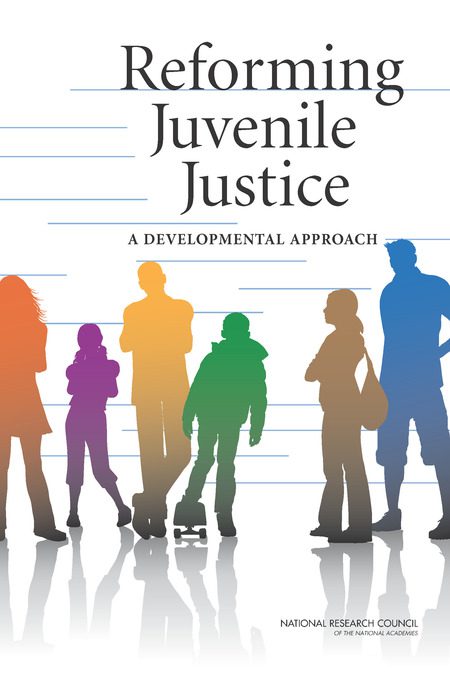 Over the past decade, state and local jurisdictions have been actively developing strategies to reduce both recidivism and spending in their juvenile justice systems. Many also seek to ensure that every youth who comes in contact with the system is met with procedural fairness at every stage of the justice system. To help accomplish these goals, juvenile justice leaders are examining and applying research and recommendations outlined in Reforming Juvenile Justice: A Developmental Approach, a seminal report released by National Research Council in 2012. This report provides an extensive review of decades of research on juvenile justice programs and practices. It also delineates how the adolescent development field can serve as a framework for developing strategies across the justice system continuum that promotes positive outcomes for youth involved with the juvenile justice system.
Specifically, the report outlines key areas that juvenile justice systems should address in order to promote healthy adolescent development. These areas include the involvement of family, positive peer groups, and activities that build decision-making and critical-thinking skills. It also discusses the aspects of adolescent brain development that influence illegal behavior in youth and the mounting evidence that such behavior desists in most adolescents as they enter young adulthood.
This research has sparked much discussion about youth culpability and to what degree adolescent offenders should be held accountable for particular crimes, given their inherent biological and neurological chemistry.[1] This discussion has in turn contributed to changes in some states where legislation distinguishes juveniles from adult offenders and where policies and practices that hold youth accountable have been modified to be more developmentally appropriate.
On July 23, 2013, the Coordinating Council on Juvenile Justice and Delinquency Prevention (Coordinating Council) held a quarterly meeting to explore how the report’s recommendations might be widely applied. The Coordinating Council serves as an independent body within the executive branch of the federal government. Its primary functions are to coordinate federal juvenile delinquency prevention programs, federal programs and activities that detain or care for unaccompanied juveniles, and federal programs relating to missing and exploited children.
At the meeting, the Office of Juvenile Justice and Delinquency Prevention (OJJDP) Administrator Robert L. Listenbee acknowledged the significance of this report. “We at OJJDP believe that this report’s findings and recommendations can transform how policymakers, practitioners, and researchers address the needs of children who are at risk for involvement or who are already involved in the juvenile justice system,” he said.[2]
At the meeting, the Committee on Assessing Juvenile Justice Reform presented on how OJJDP should consider a more developmentally appropriate approach to its grant-making decisions, policies, and program development and technical assistance activities. “If the procedures for holding youth accountable for their offending and the services provided to them are designed and operated in a developmentally informed way, this approach will promote positive legal socialization, reinforce pro-social identify, and reduce reoffending,” said Mr. Listenbee.[3]
To read more about the Coordinating Council, click here. To read about this recent meeting, click here. To read the NRC report, click here.
[1] Richard J. Bonnie, Robert L. Johnson, Betty M. Chemers, and Julie Schuck, eds., Reforming Juvenile Justice: A Developmental Approach (Washington: National Research Council of the National Academies Press, 2012).
[2] Quote was cited in the OJJDP Newsletter for July/August 2013 in an article entitled: “National Research Council Report on Juvenile Justice Reform Highlighted at Coordinating Council Meeting,” available at http://www.ojjdp.gov/newsletter/242652/pfv.html
[3] Quote was cited in the OJJDP Newsletter for July/August 2013 in an article entitled: “National Research Council Report on Juvenile Justice Reform Highlighted at Coordinating Council Meeting,” available at http://www.ojjdp.gov/newsletter/242652/pfv.html.

The CSG Justice Center Advisory Board establishes the policy and project priorities of the organization. The board features…
Read More
"AOT is a complex community intervention that can be effective or not depending on how it is implemented.…
Read More
8 states gathered to discuss workforce solutions for formerly incarcerated people.
Read More
Breaking the Cycle of Homelessness and Incarceration: Q&A with New CSG Justice Center Advisory Board Member Wayne Niederhauser
The CSG Justice Center Advisory Board establishes the policy and project priorities of the organization. The board features a cross-section of leaders who shape criminal justice policy in various parts of the country.
Read More
Involuntary Treatment for Patients in the Justice System: Q&A with Dr. Marvin Swartz
"AOT is a complex community intervention that can be effective or not depending on how it is implemented. The question about its effectiveness is better phrased as: for whom and under what conditions can AOT be effective?"
Read More
Reentry 2030 States Explore Day 1 Employment Readiness After Incarceration
8 states gathered to discuss workforce solutions for formerly incarcerated people.
Read More Local Criminal Justice System Innovations in Mental Health Services: Q&A with CSG Justice Center Advisory Board Member Dr. Doreen Williams
"It is the humane, person-centered approach that supports and stabilizes individuals, their families, and their communities."
Read More 2025 Nominations Now Open for Judges and Psychiatrists Improving Lives and Behavioral Health
The Judge Stephen S. Goss Memorial Award for Leadership has expanded to include Lifetime Achievement Awards and, in 2024, the first-ever Team Collaboration Award.
Read More Senate Passes Second Chance Reauthorization Act of 2025
On October 9, 2025, the Senate passed the Second Chance Reauthorization Act of 2025 (S. 1843), which would continue critical recidivism-reduction and reentry services nationwide.
Read More