








Washington Lawmakers, Judicial Leaders Endorse Proposal for Justice System Reform
Olympia, WA—Governor Jay Inslee, Chief Justice Barbara Madsen, and a bipartisan group of state legislators accepted a justice reinvestment policy framework for the state’s criminal justice and corrections systems on Jan. 14, capping a year of interbranch research and cooperation.
The comprehensive proposal announced by Gov. Inslee aims to reduce the state’s high rate of property crime, hold offenders more accountable on supervision, and avert growth in the state’s prison population.
“This really is a national effort,” Gov. Inslee said. “[The] Justice Reinvestment Initiative is a way to help states look for creative solutions that fit their specific circumstances.”
Washington State currently has the highest reported property crime rate in the nation. “This tells us that our incarceration-only policy is not working and needs to change,” Gov. Inslee said.
A broad taskforce of legislators, state agencies, public safety officials, and stakeholders with a comprehensive view of the state’s criminal justice system have worked since June 2014 to craft and ultimately endorse the policy framework. The proposal sets a goal of reducing property crime by 15 percent in the state by 2021.
The full report released by the Council of State Governments (CSG) Justice Center outlines the analyses and findings that resulted from this justice reinvestment process. Under the proposal, the state would require a mandatory period of post-release supervision and treatment for property offenders, and would invest in policing strategies to deter crime.
In Washington, repeat property offenders are sentenced to confinement two to three times longer than average when compared to other states with sentencing guidelines. But Washington has long had a policy of not supervising these offenders after confinement, unlike other states that use supervision as a primary way of holding them accountable. Studies show supervision and treatment are the most effective methods to reduce reoffending.
Chief Justice Madsen praised the interbranch process. “I appreciate the chance to collaborate with the other two branches on this problem,” she said. “By changing our current approach, we’re going to have an opportunity to make the justice system more effective.
“I’ve been in this justice business for 30 years, and if you don’t address the root causes of the problem, you won’t find a solution.”
Sen. Jim Hargrove (D-Hoquiam), co-chair of the committee, said the proposal showed the state’s continued commitment to evidence-based approaches to public safety.
“I’ve always said I want to be tough on crime by preventing it,” Sen. Hargrove said. “This package, if correctly implemented and funded, has the potential to dramatically reduce our property crime rate.”
By emphasizing supervision for approximately 2,000 repeat property offenders, and by funding ways to reduce recidivism, the changes would also avert growth currently projected in Washington’s prison population.
“Due to the good work of our law enforcement agencies, our state has a low violent crime rate in comparison to other states,” said Rep. Brad Klippert (R-Kennewick). “I know our law enforcement officers are essential to help solving the property crime problem in our state. This package would help enhance our efforts to reduce crime by providing local enforcement agencies with additional resources to dedicate to preventing property crimes from happening in the first place.
“By preventing crimes, we prevent victimizations, and there’s no better outcome than that.”
The Washington State Institute for Public Policy found the proposals would reduce crime by 1,000 victimizations annually and reoffending by 13 percent, compared with the status quo.
Over six years, the proposals are projected to avert up to $290 million in corrections spending.
“The justice reinvestment process allowed us to learn how we can directly tackle the unsustainable growth in our prison population,” said Nicholas Brown, General Counsel to Gov. Inslee and co-chair of the taskforce. “Our current approach of simply sentencing repeat property offenders to longer and longer terms of incarceration clearly isn’t working. This new approach embraces what the research clearly tells us works to reduce crime and recidivism.”
As part of the justice reinvestment approach, a projected $80 million of the $290 million in averted costs would be required to be reinvested in the expansion of supervision and treatment for property offenders, as well as in innovative policing strategies to deter crime, financial assistance to victims for expenses associated with property crime, and new incentive grants to bolster more cost-effective pretrial practices in the counties.
“In order for the Taskforce’s proposed strategies to succeed, the state must commit to fully fund new investments in offender supervision and programing,” said Thurston County Prosecutor Jon Tunheim.
The CSG Justice Center, in partnership with The Pew Charitable Trusts and the U.S. Department of Justice’s Bureau of Justice Assistance (BJA), has provided on-the-ground technical assistance in collaboration with state leaders to develop a policy framework to manage the projected growth of the prison population.
In early 2014, Washington Governor Jay Inslee, House Speaker Frank Chopp (D-Seattle), Senate Majority Leader Rodney Tom (D-Medina), Senate Republican Leader Mark Schoesler (R-Ritzville), Chief Justice Barbara Madsen, and Washington Department of Corrections Secretary Bernard Warner requested technical assistance from CSG Justice Center to employ a data-driven “justice reinvestment” approach to reduce corrections spending and reinvest a portion of savings in strategies that can reduce recidivism and improve public safety.

Corrections leaders balance the complex priorities of maintaining public safety, operating secure facilities, providing needed care and services…
Read More
Every day, public safety depends on thousands of state and local leaders who work across agencies,…
Read More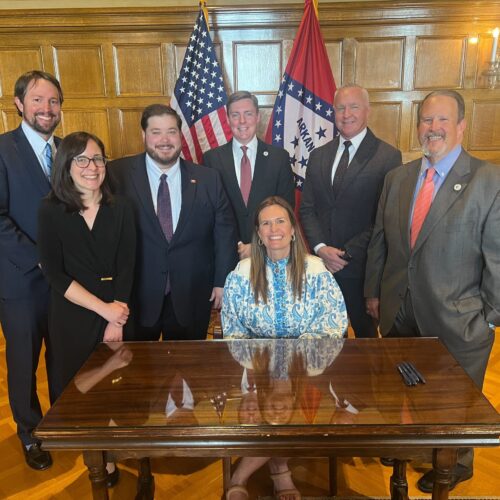
In April 2025, Arkansas Governor Sarah Huckabee Sanders signed a package of bipartisan criminal justice legislation into law,…
Read More
Apply Now for Resident Analyst Program to Increase Data Analysis Capacity at Departments of Corrections
Corrections leaders balance the complex priorities of maintaining public safety, operating secure facilities, providing needed care and services to the incarcerated population, and coordinating with other agencies.
Read More
Amid Federal Funding Cuts, Here’s How the CSG Justice Center Can Help You Advance Safety and Justice
Every day, public safety depends on thousands of state and…
Read More
Explainer: How a New Law in Arkansas Tackles Crime, Recidivism, and Community Supervision Challenges
In April 2025, Arkansas Governor Sarah Huckabee Sanders signed a package of bipartisan criminal justice legislation into law, which is designed to increase public safety and improve community supervision. The legislation passed nearly unanimously.
Read More Bipartisan Group of 88 Lawmakers Push for Continued Funding for Reentry and Recidivism Programs
A bipartisan group of 88 lawmakers, led by Representatives Carol Miller (R-WV) and Danny Davis (D-IL), wrote a letter calling for continued funding for the Second Chance Act in the Fiscal Year 2026 Commerce, Justice, Science, and Related Agencies appropriations bill.
Read More Explainer: North Dakota’s New Youth Fitness-to-Proceed Law
Last month, North Dakota Governor Kelly Armstrong signed a landmark bill to change how courts handle cases involving youth with mental health concerns or who lack the developmental maturity to understand the court process.
Read More Bipartisan Group of Lawmakers Introduces Second Chance Reauthorization Act of 2025
Today, Senators Shelley Moore Capito (R-WV) and Cory Booker (D-NJ) and Representatives Carol Miller (D-WV) and Danny K. Davis (D-IL) introduced the Second Chance Reauthorization Act of 2025 in both the Senate and U.S. House of Representatives.
Read More