









National Forum Spotlights an Integrated Framework to Reduce Recidivism and Promote Employment
On September 26, 2013, the U.S. Department of Labor (DOL) Employment and Training Administration and the U.S. Department of Justice’s Bureau of Justice Assistance (BJA), along with the Council of State Governments Justice Center (CSG Justice Center) and its partner the Annie E. Casey Foundation, hosted a national forum entitled Bridging Reentry and Workforce Development: A Shared Approach to Strengthening Communities. The event brought together more than 120 leaders from the fields of criminal justice and workforce development to discuss and share their perspectives on the importance of integrating workforce and reentry strategies to support people returning to their communities after incarceration. More than 1,000 viewers also watched the forum via livestream. Speakers discussed the implications of a new framework for using individuals’ criminogenic risk and job-readiness needs to promote public safety and employment and to prioritize scarce resources in criminal justice, reentry, and workforce systems.
In tandem with the Departments of Labor and Justice, the U.S. Department of Education has made significant strides to improve outcomes for individuals with criminal histories seeking to achieve educational goals. “We know how important it is to uplift individuals who are incarcerated and are about to be released,” said Dr. Brenda Dann-Messier, Assistant Secretary of Vocational and Adult Education at the U.S. Department of Education. “If we can help them reach their goals, they can participate in the economy and there will be stronger families and communities.”
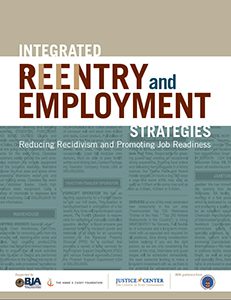 Released by BJA, with support from the Annie E. Casey Foundation and guidance from DOL, Integrated Reentry and Employment Strategies: Reducing Recidivism and Promoting Job Readiness (Integrated Strategies) features the new framework, which brings together the most current research about reducing recidivism and best practices in workforce development into one integrated approach. The approach uses a resource-allocation and service-matching tool to sort individuals according to their criminogenic needs (or factors that increase their risk of reoffending) and levels of job readiness. It then recommends integrated service packages that are tailored to meet each individual’s specific needs.
At the forum, workforce development leaders and employers engaged in discussion and shared their perspectives on the need to integrate services across systems to achieve positive reentry and employment outcomes. “Twenty years ago, law enforcement and corrections administrators would say ‘not my work, not my job.’ But today, the approach is: care, custody, control, and community,” said Dr. Stefan LoBuglio, Chief of Pre-release and Reentry Services at Montgomery County Department of Correction and Rehabilitation.
The forum highlighted New York State’s Work for Success (WFS) Initiative, and how its efforts parallel the recommendations in Integrated Strategies. Led by the state’s Department of Labor, Department of Corrections and Community Supervision, Division of Criminal Justice Services, the Office of the Deputy of Civil Rights, and by community-based organization the Center of Employment Opportunities, among other workforce development practitioners in New York, the initiative represents Governor Andrew M. Cuomo’s statewide effort to improve the employment outcomes and reduce recidivism among individuals returning from prison to their communities. WFS has already undertaken a number of innovative initiatives, and in the coming months, Work for Success will launch a coordinated referral and service delivery system which matches an individual to reentry and workforce development services based on their criminogenic needs and job-readiness assessment information.
“Because of his [Governor Andrew Cuomo’s] vision, we have created an initiative called ‘Work for Success.’ It focuses on identifying employment and training opportunities for the formerly incarcerated; as well as thinking creatively to identify synergies between the labor community, the public safety community, and the community based organizations,” said New York State Deputy Secretary of Civil Rights Alphonso David, in his opening remarks.
The State hopes that the new approach will yield the maximum cost-benefit return from its funds for public safety. “From our perspective, the risk assessment tool is an absolutely critical component of reducing recidivism. It allows us to focus on generating a return on our public safety dollars by linking those at highest risk of reincarceration to the appropriate interventions that will keep them crime-free,” said New York State Deputy Secretary of Public Safety, Thomas Abt.
Mindy Tarlow, Chief Executive Officer and Executive Director of the Center for Employment Opportunities elaborated on the initiative’s efforts to match individuals to services tailored to their risk and needs. She said the initiative currently uses “a forensic tool that identifies the people who are the highest risk of reoffending and with highest barriers to employment…and literally tries to match them to the right kind of service for them at the right time.”
The CSG Justice Center also unveiled a new online toolkit on reentry and employment at the forum. Developed with the Federal Interagency Reentry Council and experts from all over the country, this toolkit contains resources and tools to help corrections, reentry, and workforce policymakers and practitioners better integrate employment and workforce strategies. In addition, it contains user-friendly information on legal and policy issues regarding employment for individuals with criminal histories, such as links to resources on laws related to hiring and employment discrimination, legislative reforms across different states, and policies that incentivize the hiring of individuals with criminal histories.
The forum marks the start of what policymakers hope will be an ongoing conversation about how best to reduce unemployment among individuals with criminal histories. In the coming months, federal, state, and local leaders will continue to work with forum participants and criminal justice and labor stakeholders to identify the necessary tools to continue translating the research principles into practice and share lessons learned.
To read the white paper and access the toolkit, click here.
For more information on Work For Success, click here.

"It is the humane, person-centered approach that supports and stabilizes individuals, their families, and their communities."
Read More
The Judge Stephen S. Goss Memorial Award for Leadership has expanded to include Lifetime Achievement Awards and, in…
Read More
On October 9, 2025, the Senate passed the Second Chance Reauthorization Act of 2025 (S. 1843), which would…
Read More
Local Criminal Justice System Innovations in Mental Health Services: Q&A with CSG Justice Center Advisory Board Member Dr. Doreen Williams
"It is the humane, person-centered approach that supports and stabilizes individuals, their families, and their communities."
Read More
2025 Nominations Now Open for Judges and Psychiatrists Improving Lives and Behavioral Health
The Judge Stephen S. Goss Memorial Award for Leadership has expanded to include Lifetime Achievement Awards and, in 2024, the first-ever Team Collaboration Award.
Read More
Senate Passes Second Chance Reauthorization Act of 2025
On October 9, 2025, the Senate passed the Second Chance Reauthorization Act of 2025 (S. 1843), which would continue critical recidivism-reduction and reentry services nationwide.
Read More CSG Justice Center Launches First-of-Its-Kind Statewide Crisis Intervention Teams (CIT) Technical Assistance Center
The CSG Justice Center has partnered with the Pennsylvania Commission on Crime and Delinquency and CIT International to launch a first-of-its-kind statewide Technical Assistance (TA) Center.
Read More How Kentucky’s “Seth’s Law” Reduces Barriers to Care for Competency to Stand Trial and Guardianship
Read More
How Kentucky’s “Seth’s Law” Reduces Barriers to Care for Competency to Stand Trial and Guardianship
Read More
 2025 in Review: Justice Data and Solutions for State and Local Leaders Amid Federal Change
Our mission hasn’t changed; it’s become more essential. The following 2025 accomplishments are a testament to that enduring focus.
Read More