








White House Conference Discusses Challenges Faced by Children of Incarcerated Parents
Approximately three million children in the United States have an incarcerated parent, or a parent who has been recently released from incarceration. Research shows that the challenges that these children face are substantial, including difficulty with transitioning into their adult lives, lower graduation rates, higher rates of unemployment, and a higher risk of becoming involved with the criminal justice system.
On August 20, 2013, the American Bar Foundation and the National Science Foundation hosted a White House conference entitled “Parental Incarceration in the United States: Bringing Together Research and Policy to Reduce Collateral Costs to Children” in order to address the issue. Researchers, practitioners, and policymakers across the country met to review the current research, identify programs and best practices, and develop recommendations to improve outcomes. Two renowned experts in this field, Professors John Hagan of the American Bar Foundation and Northwestern University and Holly Foster of Texas A&M University, led the conferences and discussed their in-depth multi-year study that examines the effects of parental incarceration on children, their families, and their communities.
The conference is also part of the Children of Incarcerated Parents Initiative, which was launched last year. The initiative involves an interagency group—composed of the U.S. Departments of Justice, Health and Human Services, Housing and Urban Development, Education, and Agriculture as well as the Social Administration and other stakeholders—that works together to find opportunities to support these children and their guardians.

The CSG Justice Center has partnered with the Pennsylvania Commission on Crime and Delinquency and CIT International to…
Read More
Our mission hasn’t changed; it’s become more essential. The following 2025 accomplishments are a testament to that enduring…
Read More
CSG Justice Center Launches First-of-Its-Kind Statewide Crisis Intervention Teams (CIT) Technical Assistance Center
The CSG Justice Center has partnered with the Pennsylvania Commission on Crime and Delinquency and CIT International to launch a first-of-its-kind statewide Technical Assistance (TA) Center.
Read More How Kentucky’s “Seth’s Law” Reduces Barriers to Care for Competency to Stand Trial and Guardianship
Read More
2025 in Review: Justice Data and Solutions for State and Local Leaders Amid Federal Change
How Kentucky’s “Seth’s Law” Reduces Barriers to Care for Competency to Stand Trial and Guardianship
Read More
2025 in Review: Justice Data and Solutions for State and Local Leaders Amid Federal Change
Our mission hasn’t changed; it’s become more essential. The following 2025 accomplishments are a testament to that enduring focus.
Read More 25 Reentry Wins in 2025: How States Are Removing Barriers to Reentry Success
From new laws and reentry councils to increased funding and lowered barriers, these wins highlight collaboration, creativity, and innovation across our Reentry 2030 network.
Read More
Job Training in Prison: Reentry 2030 States Explore Innovative Models and Partnerships
State leaders gathered for the fourth session of the Reentry 2030 Workforce Development Peer Learning Cohort.
Read More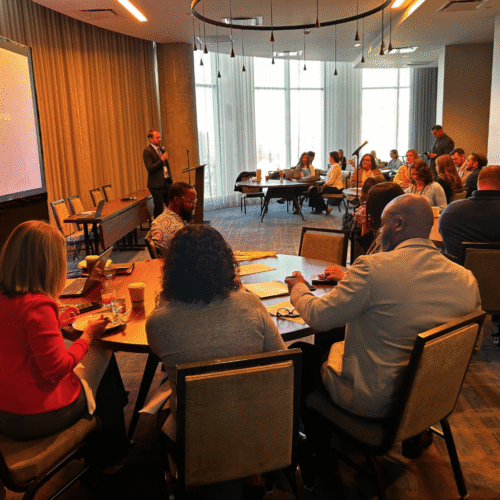 Getting the Right Response When Every Crisis Is Different: 4 States Share Lessons on Building Coordinated Crisis Systems
New Jersey, Utah, Virginia, and Washington discuss their different "Aligning Health and Safety" approaches and some of the challenges they’ve experienced.
Read More