









From National Mentoring Month to Black History Month–Highlighting the Value of Mentorship for Communities of Color and People in Reentry
Before an audience of practicing mentors, researchers, and nonprofit staff at the seventh annual National Mentoring Summit, David Shapiro, CEO of MENTOR: The National Mentoring Partnership, pointed out the fitting transition from celebrating National Mentoring Month in January to Black History Month in February. Held in Washington, DC, in early February, the summit featured several sessions that focused specifically on mentoring black youth, cultural competency, and diversity. Part of MENTOR’s mission is to “close the mentoring gap” for the one in three young people in the U.S. who do not have the support of a mentor.
“There is no such thing as other people’s children,” Shapiro said. “We all have a responsibility.”
Summit participants engaged in workshops on a variety of topics, including those relevant to mentoring youth of color. One workshop stressed the importance of extending mentoring resources to young black males who are struggling, but also to those who are high achieving. Approaches to mentoring boys of color should not be monolithic, said L-Mani S. Viney, executive director of the Kappa Alpha Psi Foundation, in a workshop called “The Urgency to Redefine Support for Black Male Achievement in Mentoring.”
According to Viney, who has been an educator for nearly two decades and has led numerous mentoring programs for young men of color, there also needs to be a shift in the way mentoring programs measure success. Rather than using deficit-based measures, he said, mentoring programs should employ an asset-based paradigm and use language that highlights positives rather than negatives—promoting “wellness” instead of addressing “illness,” for example.
An emphasis on terminology carried through other workshops as well. Broadening the scope of the summit beyond youth, a workshop called “Mentoring as a Component of Reentry: Considerations and Next Steps” addressed strategies for using mentoring relationships to supplement services for adults who are returning to their communities after incarceration. Led by Ronin A. Davis and Jan De la Cruz of The Council of State Governments Justice Center, the workshop engaged attendees in a discussion about how to work with corrections and community supervision agencies to provide reentry mentoring services and what types of training are necessary for mentors who work with the adult reentry population.
Workshop attendees raised the need to train reentry mentors to avoid using terms such as “ex-felon,” “ex-offender,” and “convict” for people in the criminal justice system.
“We would never want mentors to refer to the mentees [using] negative terminology that’s associated with incarceration,” said Ronald Day, associate vice president of the David Rothenberg Center for Public Policy at the Fortune Society, a New York City organization that was awarded a Second Chance Act adult mentoring grant in 2016. Day, who has firsthand experience of incarceration, chooses to identify himself as an executive, a college-level instructor, and a student who is about to earn a doctorate before identifying as someone with a criminal record. To combat some of the stereotypes about people in the criminal justice system, he said, “you have to let people know what else you are.”
Learn more from MENTOR about cultural competency and mentoring boys and young men of color.

The CSG Justice Center has partnered with the Pennsylvania Commission on Crime and Delinquency and CIT International to…
Read More
Our mission hasn’t changed; it’s become more essential. The following 2025 accomplishments are a testament to that enduring…
Read More
CSG Justice Center Launches First-of-Its-Kind Statewide Crisis Intervention Teams (CIT) Technical Assistance Center
The CSG Justice Center has partnered with the Pennsylvania Commission on Crime…
Read More How Kentucky’s “Seth’s Law” Reduces Barriers to Care for Competency to Stand Trial and Guardianship
Read More
2025 in Review: Justice Data and Solutions for State and Local Leaders Amid Federal Change
How Kentucky’s “Seth’s Law” Reduces Barriers to Care for Competency to Stand Trial and Guardianship
Read More
2025 in Review: Justice Data and Solutions for State and Local Leaders Amid Federal Change
Our mission hasn’t changed; it’s become more essential. The following 2025 accomplishments…
Read More 25 Reentry Wins in 2025: How States Are Removing Barriers to Reentry Success
From new laws and reentry councils to increased funding and lowered barriers,…
Read More
Job Training in Prison: Reentry 2030 States Explore Innovative Models and Partnerships
State leaders gathered for the fourth session of the Reentry 2030 Workforce…
Read More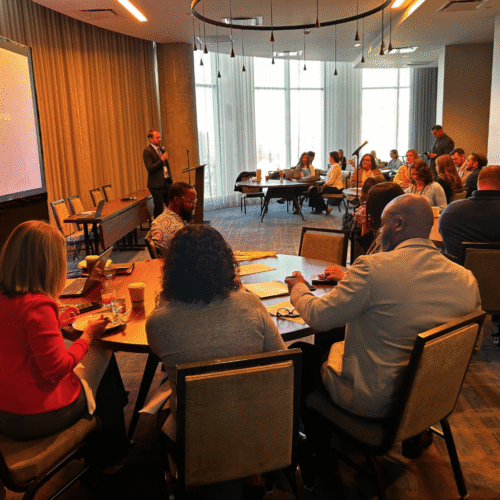 Getting the Right Response When Every Crisis Is Different: 4 States Share Lessons on Building Coordinated Crisis Systems
New Jersey, Utah, Virginia, and Washington discuss their different "Aligning Health and Safety"…
Read More