





New Report Reveals South Carolina Student Absences Got Worse When Juvenile Justice Systems Stepped In
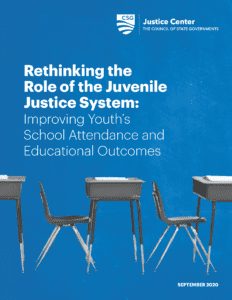 Many states and school districts across the country use the juvenile justice system to address chronic absences and other school performance issues. But new, first-of-its-kind research from The Council of State Governments (CSG) Justice Center raises significant concerns about this approach.
Rethinking the Role of the Juvenile Justice System: Improving Youth’s School Attendance and Educational Outcomes reveals that kids involved in the juvenile justice system in South Carolina not only didn’t experience attendance improvements, but their attendance actually got worse; kids missed five more days of school on average than they had in the year before their juvenile justice involvement. Even kids who received court oversight and the threat of further sanctions specifically designed to get them to attend school more did not experience any improvements in their attendance compared to their peers.
There’s little argument that school attendance and completion have long-term benefits, including reduced crime and improved labor market earnings. So, it’s understandable that state and local leaders are concerned about kids who struggle with excessive school absences. But the reasons students aren’t engaged in class and struggle with absences were individual and complex before COVID-19 was thrust into every American family. And they’re likely to be even more complicated now.
Using juvenile justice sanctions to motivate changes to kids’ school behavior is an issue many states struggle with. In about half of states, truancy is a crime. Even in states that have decriminalized truancy, youth can frequently still be sent to court for too many school absences. In 2018, U.S. schools referred more than 60,000 students—disproportionately kids of color—to court for truancy. Since 2010, referrals for almost all other types of juvenile offenses have declined, but court referrals for truancy have actually increased in recent years.
The CSG Justice Center study also raises questions about whether some schools’ policies and practices actually make it harder for justice-involved youth to engage and succeed in school. Some schools in South Carolina, and in other communities across the country, take punitive measures when kids become involved with the juvenile justice system, including barring them from attending in-person classes, automatically suspending or expelling them, and requiring them to attend alternative schools. These approaches make it harder, not easier, for kids to stay connected to the positive adults, peers, and activities that are critical to successful education.
This new research compels policymakers, judges, attorneys, probation directors, and educators to wrestle with an important question: are juvenile justice system involvement and school disciplinary measures really the most appropriate and effective ways to help kids succeed in school?
Read the full report.
 Rethinking the Role of the Juvenile Justice System: Improving Youth’s School Attendance and Educational Outcomes
This webinar presents findings from an unprecedented study conducted by the CSG Justice Center on the impact of…
About the Author

On October 9, 2025, the Senate passed the Second Chance Reauthorization Act of 2025 (S. 1843), which would…
Read More
The CSG Justice Center has partnered with the Pennsylvania Commission on Crime and Delinquency and CIT International to…
Read More
Senate Passes Second Chance Reauthorization Act of 2025
On October 9, 2025, the Senate passed the Second Chance Reauthorization Act…
Read More
CSG Justice Center Launches First-of-Its-Kind Statewide Crisis Intervention Teams (CIT) Technical Assistance Center
The CSG Justice Center has partnered with the Pennsylvania Commission on Crime…
Read More How Kentucky’s “Seth’s Law” Reduces Barriers to Care for Competency to Stand Trial and Guardianship
Read More
How Kentucky’s “Seth’s Law” Reduces Barriers to Care for Competency to Stand Trial and Guardianship
Read More
 2025 in Review: Justice Data and Solutions for State and Local Leaders Amid Federal Change
Our mission hasn’t changed; it’s become more essential. The following 2025 accomplishments…
Read More 25 Reentry Wins in 2025: How States Are Removing Barriers to Reentry Success
From new laws and reentry councils to increased funding and lowered barriers,…
Read More
Job Training in Prison: Reentry 2030 States Explore Innovative Models and Partnerships
State leaders gathered for the fourth session of the Reentry 2030 Workforce…
Read More