








Executive Working Group Meets to Discuss Community Intervention and Correctional Responses to Domestic Violence in Rhode Island
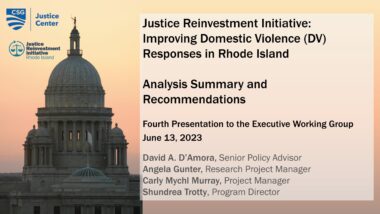
On June 13, 2023, CSG Justice Center staff concluded their analysis of domestic violence responses in Rhode Island and presented recommendations to the Domestic Violence Executive Working Group. Recommendations were based on the analysis of data collected between June 2022 and June 2023.
The analysis, supported by the Rhode Island Department of Corrections, used Sequential Intercept Mapping to study responses to domestic violence. Sequential Intercept Mapping of Rhode Island’s domestic violence responses, adapted from the Sequential Intercept Model, allowed CSG Justice Center staff to assess what programs, supports, barriers, and gaps exist for victims and survivors as well as individuals who have committed domestic violence at various points, or intercepts, in the system. The five intercepts analyzed in this assessment were community services, law enforcement, initial detention and court hearings, systems responses, and reentry and community supervision.
The recommendations presented at the meeting were informed by interviews, surveys, and focus groups with over 230 individuals across these intercepts and analyses of over 96,000 case files from the Rhode Island Coalition Against Domestic Violence, Domestic Violence and Sexual Assault Training and Monitoring Unit, the judiciary, and Department of Corrections. The CSG Justice Center recommended that Rhode Island do the following:
- Use comprehensive, evidence-informed domestic violence education, training, approaches, and policies across community, behavioral health, human service, and criminal justice systems to create more consistent responses for victims and survivors, as well as individuals who commit domestic violence.
- Improve how domestic violence data is collected, reported, and used to increase understanding of domestic violence prevalence, characteristics, and responses across the state.
- Invest sufficient and sustained resources to ensure that all domestic violence victims and survivors are supported. Also, work to ensure that programs for people who commit domestic violence are delivered in ways that anticipate and address common barriers to program success, such as poverty, unstable housing, substance use, mental health, geographic isolation, and other challenges.
- Increase the availability, accessibility, and responsivity of programming for victims and survivors, as well as individuals who have committed violence, accounting for differences in language, physical ability, geography, gender and sexual identity, race and ethnicity, socioeconomic factors, and other considerations.
- Create shared parameters for partnerships among community, behavioral health, human service, and criminal justice agencies, including defining partners’ roles and responsibilities and information sharing to create more streamlined services and eliminate gaps or duplication in service provision for victims and survivors and people who have committed domestic violence.
- Make statutory changes to better support victims and survivors and increase resources for accountability, including modifications to Batterers Intervention Programming, for people who have committed domestic violence.
The Executive Working Group will meet in July 2023 to discuss recommendations in more depth and vote on which ones to move forward for approval by the governor.
This project was supported by Grant No. 2020-ZB-BX-0022 awarded by the Bureau of Justice Assistance. The Bureau of Justice Assistance is a component of the Department of Justice’s Office of Justice Programs, which also includes the Bureau of Justice Statistics, the National Institute of Justice, the Office of Juvenile Justice and Delinquency Prevention, the Office for Victims of Crime, and the SMART Office. Points of view or opinions in this document are those of the author and do not necessarily represent the official position or policies of the U.S. Department of Justice.

8 states gathered to discuss workforce solutions for formerly incarcerated people.
Read More
"It is the humane, person-centered approach that supports and stabilizes individuals, their families, and their communities."
Read More
The Judge Stephen S. Goss Memorial Award for Leadership has expanded to include Lifetime Achievement Awards and, in…
Read More
Reentry 2030 States Explore Day 1 Employment Readiness After Incarceration
8 states gathered to discuss workforce solutions for formerly incarcerated people.
Read More
Local Criminal Justice System Innovations in Mental Health Services: Q&A with CSG Justice Center Advisory Board Member Dr. Doreen Williams
"It is the humane, person-centered approach that supports and stabilizes individuals, their families, and their communities."
Read More
2025 Nominations Now Open for Judges and Psychiatrists Improving Lives and Behavioral Health
The Judge Stephen S. Goss Memorial Award for Leadership has expanded to include Lifetime Achievement Awards and, in 2024, the first-ever Team Collaboration Award.
Read More Senate Passes Second Chance Reauthorization Act of 2025
On October 9, 2025, the Senate passed the Second Chance Reauthorization Act of 2025 (S. 1843), which would continue critical recidivism-reduction and reentry services nationwide.
Read More CSG Justice Center Launches First-of-Its-Kind Statewide Crisis Intervention Teams (CIT) Technical Assistance Center
The CSG Justice Center has partnered with the Pennsylvania Commission on Crime and Delinquency and CIT International to launch a first-of-its-kind statewide Technical Assistance (TA) Center.
Read More