









Youth Justice Action Month: Practical Solutions and Resources for Building a Future Where Youth Thrive
When a 15-year-old was suspended from school three times last year, the suspensions spiraled into unexcused skipped days, which eventually led to a truancy referral to court, even though the real issue was undiagnosed anxiety—not defiance. The result? The teen was placed on probation, which required meeting conditions—such as a strict curfew—that made it even harder to stay in school.
This experience isn’t unique.
Youth across the country are dealing with significant mental health, education, family, and community challenges that public systems are struggling to address. And many states are resorting to harsh punishments that don’t address the root issues.
To build a future where youth thrive—which is the theme of this year’s Youth Justice Action Month—leaders must use research-based, cross-system solutions to prevent youth who pose minimal risk to public safety from defaulting into the justice system and ensure that youth who are high risk receive the services they need. That means improving communities and every part of the system a young person encounters—schools, courts and probation, behavioral health providers.
Here are some practical solutions and resources the CSG Justice Center has developed to improve outcomes for youth and juvenile justice systems:
Keeping Youth in School and Preparing Them for Employment
For many young people, the path into the justice system starts at school with something as commonplace as a suspension. Once youth are in the system, they can be locked out of education and job opportunities, and these barriers follow them even after they’re out of the system.
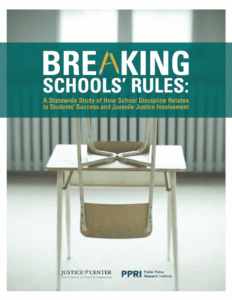
This study of nearly 1 million public secondary school students in Texas showed that when students are suspended or expelled, the likelihood that they will repeat a grade, not graduate, and/or become involved in the juvenile justice system increases significantly.
This report summarizes key findings from a research study conducted by the CSG Justice Center on the impact of juvenile justice system involvement—particularly probation—on school attendance in South Carolina. It challenges jurisdictions across the country to reconsider whether system involvement is the most appropriate and effective way to promote youth’s school success. Two supplementary infographics offer quick takes on truancy and probation, along with concrete policy recommendations for communities.
Locked Out: Improving Educational and Vocational Outcomes for Incarcerated Youth
This brief highlights key findings from and policy recommendations based on a 50-state survey of juvenile corrections agencies and how they can improve college and career readiness for incarcerated youth.
On Track: How Well Are States Preparing Youth in the Juvenile Justice System for Employment?
Drawing on 50-state survey data, this brief sheds light on a stark truth: Most incarcerated youth can’t access the workforce development resources they need to find employment after release. It also establishes a baseline for understanding how juvenile corrections agencies are addressing that gap.
Reducing Structural Barriers to School and Work for People with Juvenile Records
This brief outlines policy solutions to address findings from an analysis of education and employment barriers, which found that most postsecondary institutions and employers ask about criminal history or require background checks, and almost none distinguish between a juvenile record and an adult conviction.
Improving Juvenile Courts and Probation
Juvenile court judges make decisions that shape the lives of young people and the safety of our communities. However, most states don’t require these judges to receive any training on adolescent development or juvenile justice best practices. That gap extends to probation as well. Many juvenile probation agencies and courts are oriented around monitoring compliance with a long list of probation conditions that can set youth up for failure, push them deeper into the system, and perpetuate system inequities rather than support their success and community safety.
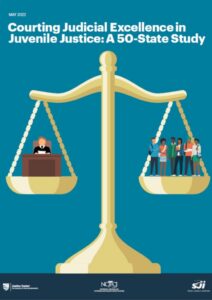
Our 2021 analysis of how juvenile courts are structured and operate in all 50 states revealed that most states do not set judges up to make decisions that improve public safety and youth outcomes. To address this, the CSG Justice Center created a unique, national juvenile justice training program for judges across the country. We’re also providing three states with intensive assessment of and technical assistance for their delinquency court systems.
This project shares findings and calls to action from a 50-state study on how states treat youth who commit status offenses—that is, behaviors that are not even crimes—and young children who don’t have the developmental capacity to fully understand the crimes they are committing. We recommend that juvenile courts refocus on youth who commit serious and/or violent offenses and for states to develop more systemic, community-based responses.
Breaking the Rules: Rethinking Condition Setting and Enforcement in Juvenile Probation
This toolkit helps juvenile probation agencies, courts, and their key partners work together to reform their current approaches to condition setting and enforcement. A companion 50-state scan found that many states impose an average of 8–10 probation conditions per youth, and enforcement often occurs subjectively in ways that can set youth up for failure.
Meeting Youth’s Health and Behavioral Health Needs
Policymakers, public agencies, and communities are increasingly concerned about youth crime, violence, and school absences, but many are not addressing the unmet behavioral health needs that often play a key role in juvenile justice involvement. Nationally, 7 out of 10 youth in detention have a diagnosable mental health condition, compared to only 2 out of 10 youth in the general population. Even when youth are identified as having high risk and needs to reoffend, they still often don’t receive the type or amount of services needed to reduce those.
Navigating Concerns on Youth Crime, Violence, and Behavioral Health: What Does the Data Say?
This tool compiles the most recent data on youth mental health, victimization, arrests, court involvement, and detention to help policymakers refocus juvenile justice resources on youth who commit serious and violent offenses while ensuring all youth get the services they need.
This CSG Justice Center initiative helps leaders identify, implement, and expand policies and best practices to safely reduce detention and increase connections to care for young people with serious behavioral health needs. In 2024, Kansas became the first state to launch Stepping Up for Youth.
This study of more than 32,000 youth across two states found that some of the most common risk factors—like substance use—are poor predictors of reoffending, while more subtle needs—like family dynamics and attitudes—matter more. The findings offer critical insights into how to redirect supervision, case planning, services, and funding strategies toward what actually reduces reoffending.
Building Community-Based, Cross-Systems Solutions
Without cross-systems, research-based solutions, many states are implementing either ineffective policies that fail to address the root causes of youth crime or isolated initiatives that have limited impact. These challenges are often exacerbated by workforce shortages and burnout across probation, courts, and behavioral health systems—making even good policies difficult to sustain. States must bring together justice, health, education, and community partners to build coordinated strategies that meet youth’s needs and improve public safety.
 Collaborating for Youth and Public Safety Initiative (CYPSI)
Through CYPSI, the CSG Justice Center provides states with free technical assistance to develop and implement statewide action plans that use limited resources more efficiently and make communities safer, reduce youth violence, and improve behavioral health and education outcomes for youth.
This brief summarizes a comprehensive review of rigorous research on restorative justice and credible messenger practices—two community-driven approaches growing in popularity that can improve education and health outcomes for youth, victims, and communities. It also outlines implementation considerations and shares real program examples.
Grounded in two decades of research and lessons learned on what works, this brief and the accompanying fact sheets detail shorter-term hiring and retention best practices that can help jurisdictions rethink their juvenile justice staffing and workforce.
Ready to Build This Future in Your State?
The 15-year-old from the beginning of this post didn’t have to end up on probation.
In a system where schools, courts, behavioral health providers, and communities work together, that teen’s behavioral health needs could have been addressed instead of punished. That’s the future we’re helping states build.
If you’re a state or local leader looking for data-driven, cross-systems solutions to youth justice challenges, contact us to see how we can help or explore additional solutions we offer.