






Breaking Schools’ Rules
A Statewide Study on How School Discipline Relates to Students’ Success and Juvenile Justice Involvement
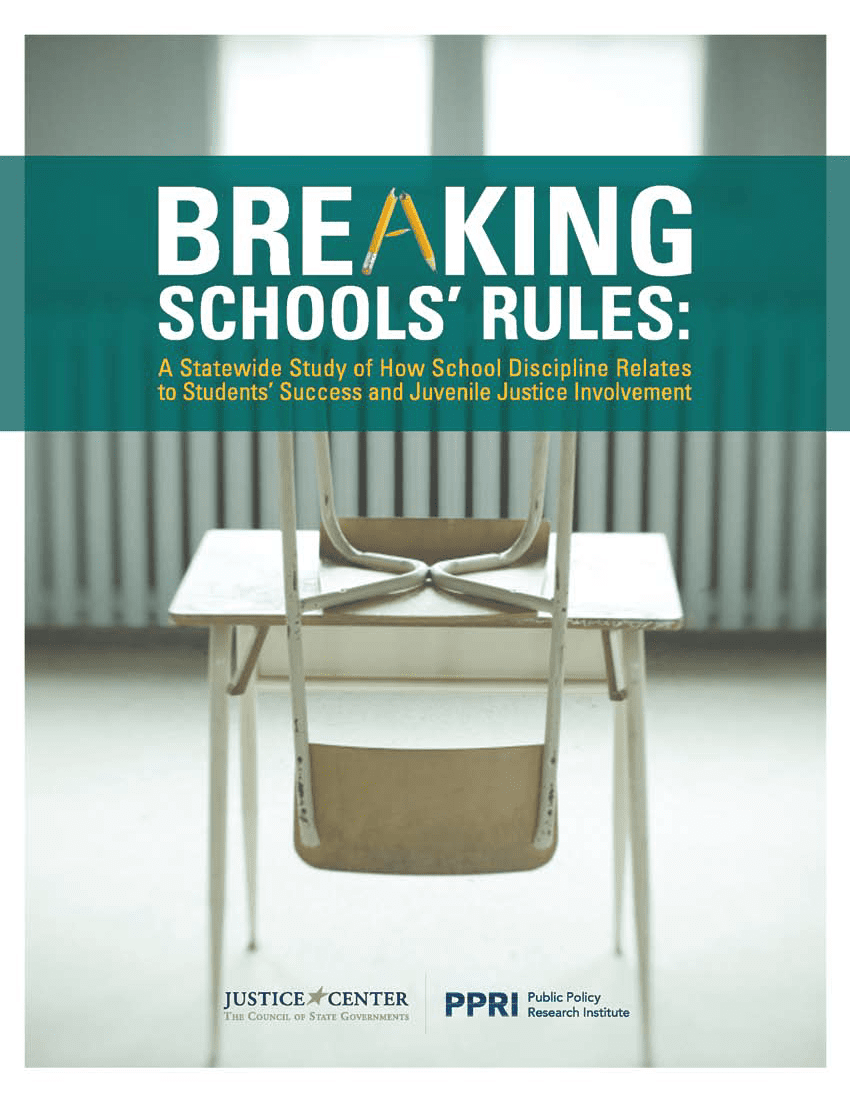
The CSG Justice Center, in partnership with the Public Policy Research Institute at Texas A&M University, has released a groundbreaking statewide study of nearly 1 million Texas public secondary school students, followed for at least six years. Funded by the Atlantic Philanthropies and the Open Society Foundations, this study found that when students are suspended or expelled, the likelihood that they will repeat a grade, not graduate, and/or become involved in the juvenile justice system increases significantly. African-American students and children with particular educational disabilities who qualify for special education were suspended and expelled at especially high rates.
Key Findings
Of the nearly 1 million public secondary school students studied, about 15 percent were suspended or expelled 11 times or more; nearly half of these students with 11 or more disciplinary actions were also involved in the juvenile justice system.
- Repeated suspensions and expulsions predicted poor academic outcomes. Only 40 percent of students disciplined 11 times or more graduated from high school during the study period, and 31 percent of students disciplined one or more times repeated their grade at least once.
- Only three percent of the disciplinary actions were for conduct in which state law mandated suspensions and expulsions; the rest were made at the discretion of school officials primarily in response to violations of local schools’ conduct codes.
- African-American students and those with particular educational disabilities were disproportionately disciplined for discretionary actions.


On October 9, 2025, the Senate passed the Second Chance Reauthorization Act of 2025 (S. 1843), which would…
Read More
The CSG Justice Center has partnered with the Pennsylvania Commission on Crime and Delinquency and CIT International to…
Read More
Senate Passes Second Chance Reauthorization Act of 2025
On October 9, 2025, the Senate passed the Second Chance Reauthorization Act of 2025 (S. 1843), which would continue critical recidivism-reduction and reentry services nationwide.
Read More
CSG Justice Center Launches First-of-Its-Kind Statewide Crisis Intervention Teams (CIT) Technical Assistance Center
The CSG Justice Center has partnered with the Pennsylvania Commission on Crime and Delinquency and CIT International to launch a first-of-its-kind statewide Technical Assistance (TA) Center.
Read More How Kentucky’s “Seth’s Law” Reduces Barriers to Care for Competency to Stand Trial and Guardianship
Read More
How Kentucky’s “Seth’s Law” Reduces Barriers to Care for Competency to Stand Trial and Guardianship
Read More
 2025 in Review: Justice Data and Solutions for State and Local Leaders Amid Federal Change
Our mission hasn’t changed; it’s become more essential. The following 2025 accomplishments are a testament to that enduring focus.
Read More 25 Reentry Wins in 2025: How States Are Removing Barriers to Reentry Success
From new laws and reentry councils to increased funding and lowered barriers, these wins highlight collaboration, creativity, and innovation across our Reentry 2030 network.
Read More
Job Training in Prison: Reentry 2030 States Explore Innovative Models and Partnerships
State leaders gathered for the fourth session of the Reentry 2030 Workforce Development Peer Learning Cohort.
Read More