








Improving School Discipline in School Systems
Suspensions dropped 20 percent nationally between 2011 and 2014, according to the U.S. Department of Education, and in many states the reductions were even more dramatic. Despite this progress, states have struggled to reduce disparities in the use of school discipline for youth of color, and educators and parents have pushed back against school discipline reforms, arguing that efforts to limit suspensions have led to more disruptions in the classroom.
In 2017, the CSG Justice Center released Realizing the Full Vision of School Discipline Reform: A Framework for Statewide Change. Funded by the Open Society Foundations, this report documents how five states have reduced their reliance on harmful school discipline practices and provides recommendations to support policymakers and education leaders to take the critical steps needed to move toward a more comprehensive vision of school discipline reform—one that ensures efforts to limit disciplinary removals also foster supportive learning environments that keep all students engaged in school and improve student outcomes.
Previously, to help states and local school districts reduce the use of exclusionary discipline, the CSG Justice Center launched a national consensus-building project that convened experts in fields such as school safety, behavioral health, education, juvenile justice, social services, law enforcement, and child welfare. Youth, parents, and community partners also played a critical and active role in the project. The resulting School Discipline Consensus Report provides policy and practice recommendations and implementation guidance to minimize the dependence on suspensions and expulsions to manage student behavior, improve students’ academic outcomes, reduce their involvement in the juvenile justice system, and promote safe and productive learning environments.
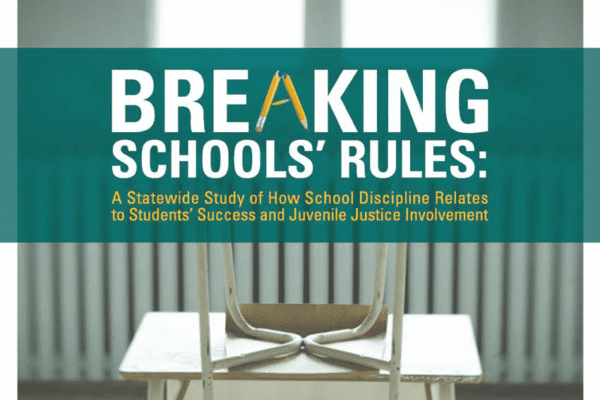
In 2011, the CSG Justice Center, in partnership with the Public Policy Research Institute at Texas A&M University, released Breaking Schools’ Rules, an unprecedented statewide study of nearly 1 million Texas public secondary school students. Funded by The Atlantic Philanthropies and the Open Society Foundations, the study found that the majority of students were suspended or expelled at least once between seventh to twelfth grade. When students are removed from the classroom as a disciplinary measure, the odds increase dramatically that the student will repeat a grade, drop out, or become involved in the juvenile justice system. These negative consequences disproportionately affect children of color as well as students with special needs.

While corrections agencies across the country collect vast amounts of data and make significant investments in…
Read More
19 states were recently granted permission by CMS to reimburse critical reentry services with Medicaid funding for up…
Read MorePurpose of the Analysis This analysis, which accompanies our article, A “Once in a Generation Opportunity”…
Read More
How Embedded Data Analysts Are Transforming State Corrections Systems
While corrections agencies across the country collect vast amounts of…
Read More
A “Once in a Generation Opportunity” to Improve Reentry for Nearly 2 Million People
19 states were recently granted permission by CMS to reimburse critical reentry services with Medicaid funding for up to 5 years.
Read More Methodology: Estimating the Opportunity of the 1115 Medicaid Reentry Waivers
Purpose of the Analysis This analysis, which accompanies our article,…
Read More First-of-its-Kind Plan for States to Support Children and Families with Incarcerated Parents
Our plan—developed with the National Resource Center on Children & Families of the Incarcerated at Rutgers University-Camden and the Institute for Municipal and Regional Policy at UConn—provides evidence-based, trauma-informed strategies for corrections leaders and policymakers to strengthen parent-child connections and reduce recidivism.
Read More Breaking the Cycle of Homelessness and Incarceration: Q&A with New CSG Justice Center Advisory Board Member Wayne Niederhauser
The CSG Justice Center Advisory Board establishes the policy and project priorities of the organization. The board features a cross-section of leaders who shape criminal justice policy in various parts of the country.
Read More Involuntary Treatment for Patients in the Justice System: Q&A with Dr. Marvin Swartz
"AOT is a complex community intervention that can be effective or not depending on how it is implemented. The question about its effectiveness is better phrased as: for whom and under what conditions can AOT be effective?"
Read More