








Financial Support for Victims of Crime: A Quick Guide for Corrections and Community Supervision Officers
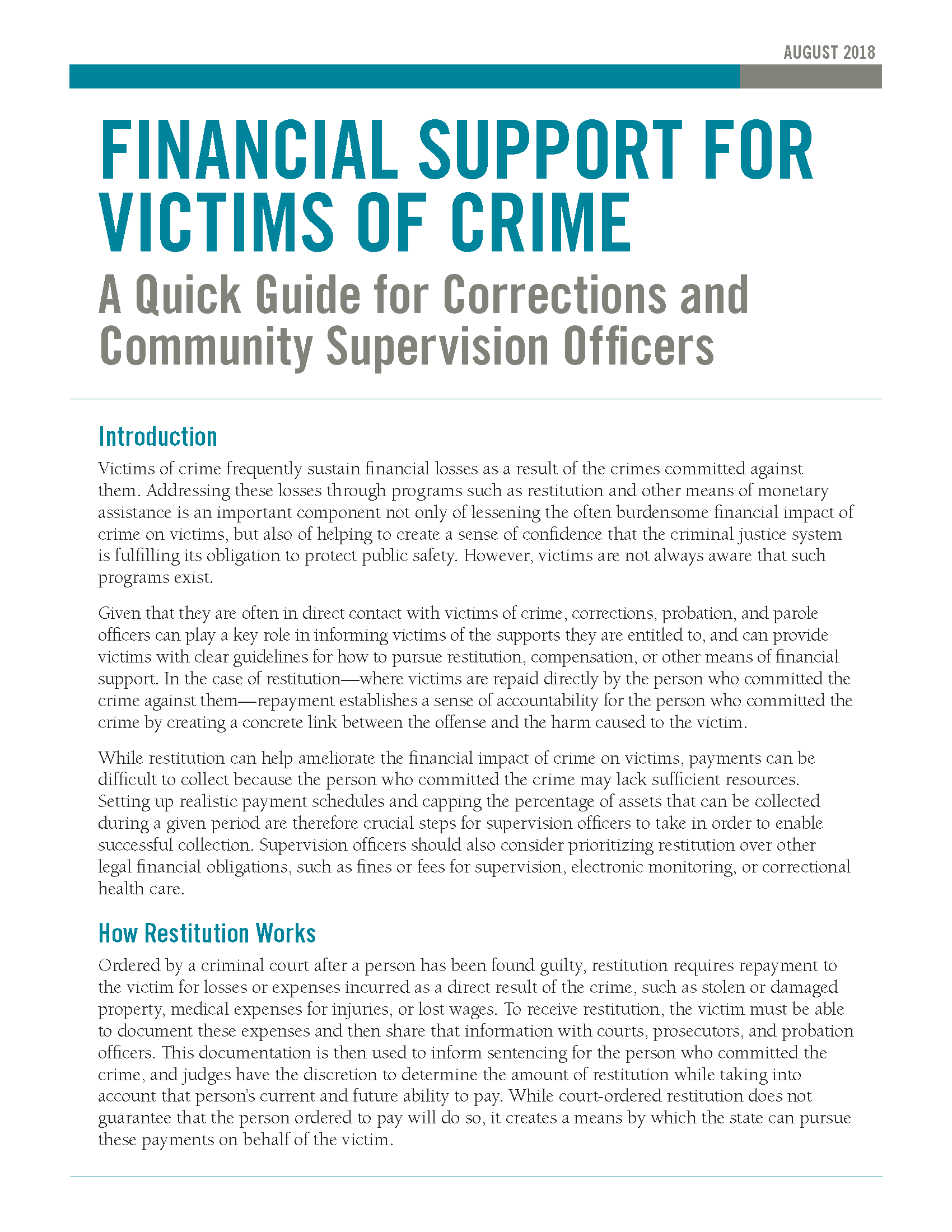
This brief from the National Reentry Resource Center outlines the role that corrections, probation, and parole officers can play in informing victims of the supports to which they are entitled and how they can pursue restitution, compensation, or other means of financial support. In the case of restitution—where victims are repaid directly by the person who committed the crime against them—repayment establishes a sense of accountability for the person who committed the crime by creating a concrete link between the offense and the harm caused to the victim.
The CSG Justice Center prepared this document for the National Reentry Resource Center with input from the National Center for Victims of Crime.
New Mexico launched a pilot program in 2024 to divert people with mental health needs and misdemeanor charges…
Read More
As the Stepping Up initiative marks its 10th year, America’s justice and behavioral health systems are facing a…
Read More
On June 26, the CSG Justice Center convened state leaders in workforce development, education, and corrections from 7…
Read More
From Courtroom to Care: 5 Key Strategies Behind New Mexico’s Competency Diversion Pilot
New Mexico launched a pilot program in 2024 to divert people with mental health needs and misdemeanor charges out of the justice system and into care.
Read More
The 10-Year Impact—and Future—of Stepping Up: Facing the Behavioral Health Crisis in Jails and Communities with Real Solutions
As the Stepping Up initiative marks its 10th year, America’s justice and behavioral health systems are facing a shared crisis: how to meet the behavioral health needs of people cycling through jails.
Read More
Breaking Down Barriers: Reentry 2030 States Meet to Tackle Employment-Related Collateral Consequences
On June 26, the CSG Justice Center convened state leaders in workforce development, education, and corrections from 7 Reentry 2030 states for the second session of the Reentry 2030 Workforce Development Peer Learning Cohort.
Read More How Embedded Data Analysts Are Transforming State Corrections Systems
While corrections agencies across the country collect vast amounts of…
Read More A “Once in a Generation Opportunity” to Improve Reentry for Nearly 2 Million People
19 states were recently granted permission by CMS to reimburse critical reentry services with Medicaid funding for up to 5 years.
Read More First-of-its-Kind Plan for States to Support Children and Families with Incarcerated Parents
Our plan—developed with the National Resource Center on Children & Families of the Incarcerated at Rutgers University-Camden and the Institute for Municipal and Regional Policy at UConn—provides evidence-based, trauma-informed strategies for corrections leaders and policymakers to strengthen parent-child connections and reduce recidivism.
Read More