







Juvenile Community Supervision Improvement
The Improving Outcomes for Youth in Confinement and While under Community Supervision Program provides grants to states, units of local government, and federally recognized tribal governments that support the development and implementation of comprehensive plans to improve reentry outcomes for incarcerated youth and youth under community supervision. It does so by promoting evidence-based strategies to reduce recidivism, improve other outcomes, and prevent any further progression into the juvenile justice system. The U.S. Department of Justice’s Office of Juvenile Justice and Delinquency Prevention (OJJDP) administers the awards.
Objectives and Deliverables
The Ensuring Public Safety and Improving Outcomes for Youth in Confinement and While under Community Supervision program supports treatment services for youth with co-occurring mental illnesses and substance addictions, reentry services for youth who were previously involved in gangs, and improved community supervision practices for youth who are placed on probation or are being released from secure confinement.
The objectives of this program are to:
- Plan and convene advisory group meetings that include leadership from juvenile justice, behavioral health, probation, social service, corrections, and other agencies that provide medical services in youth facilities, with the goal of developing a comprehensive range of recovery support services that can be provided through partnerships before and after release;
- Improve screening and assessment processes and tools;
- Develop collaborative comprehensive case management strategies;
- Improve information-sharing capabilities to carry out comprehensive case plans and family engagement strategies;
- Plan for screening youth who enter the secure facility for substance addictions and mental illnesses;
- Incorporate evidence-based practices—including cognitive behavioral health interventions to address criminogenic risk before and after release—and evidence-based services—such as medication-assisted treatment—when appropriate; and
- Develop and implement transition planning procedures to ensure that linkages to needed services and benefits are available.
For more information, see the most recent OJJDP grant solicitation.
Current and Past Grantees
OJJDP has awarded 16 grants through this program:
- 6 grants in 2015
- 5 grantsin 2016
- 4 grants for services for youth with co-occurring mental illnesses and substance addictions and 1 grant for services for youth who were previously involved in gangs in 2018

The CSG Justice Center has partnered with the Pennsylvania Commission on Crime and Delinquency and CIT International to…
Read More
Our mission hasn’t changed; it’s become more essential. The following 2025 accomplishments are a testament to that enduring…
Read More
CSG Justice Center Launches First-of-Its-Kind Statewide Crisis Intervention Teams (CIT) Technical Assistance Center
The CSG Justice Center has partnered with the Pennsylvania Commission on Crime and Delinquency and CIT International to launch a first-of-its-kind statewide Technical Assistance (TA) Center.
Read More How Kentucky’s “Seth’s Law” Reduces Barriers to Care for Competency to Stand Trial and Guardianship
Read More
2025 in Review: Justice Data and Solutions for State and Local Leaders Amid Federal Change
How Kentucky’s “Seth’s Law” Reduces Barriers to Care for Competency to Stand Trial and Guardianship
Read More
2025 in Review: Justice Data and Solutions for State and Local Leaders Amid Federal Change
Our mission hasn’t changed; it’s become more essential. The following 2025 accomplishments are a testament to that enduring focus.
Read More 25 Reentry Wins in 2025: How States Are Removing Barriers to Reentry Success
From new laws and reentry councils to increased funding and lowered barriers, these wins highlight collaboration, creativity, and innovation across our Reentry 2030 network.
Read More
Job Training in Prison: Reentry 2030 States Explore Innovative Models and Partnerships
State leaders gathered for the fourth session of the Reentry 2030 Workforce Development Peer Learning Cohort.
Read More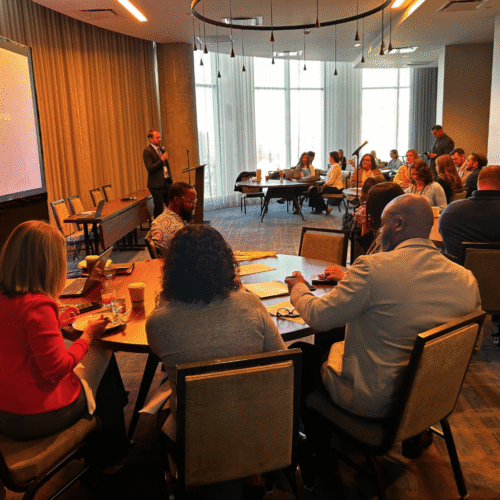 Getting the Right Response When Every Crisis Is Different: 4 States Share Lessons on Building Coordinated Crisis Systems
New Jersey, Utah, Virginia, and Washington discuss their different "Aligning Health and Safety" approaches and some of the challenges they’ve experienced.
Read More