





As community-based criminal justice practitioners navigate the new world of COVID-19, a majority of them are already halting the essential services they provide to help people returning from prison or jail reenter successfully.
A survey of reentry service providers conducted by The Council of State Governments (CSG) Justice Center this month showed that 75 percent of 126 respondents said they had stopped providing some services or closed operation entirely since the rise of the pandemic.
Those service disruptions are coupled with financing challenges that are prompting a growing collection of tough decisions already being made by leaders of these operations. About 45 percent of respondents say they face challenges with maintaining cash flow, and nearly half of those surveyed are concerned about their ability to keep their doors open. Nearly one in five organizations report they have already laid off workers, and an additional 9 percent expect layoffs in the future.
Despite the curtailing of these critical programs and corresponding cuts, nearly half of the providers polled are seeing an increase in requests for services, according to the survey.
“The value of these reentry services can’t be overstated,” said Megan Quattlebaum, director of the CSG Justice Center. “They can mean the difference between finding an apartment and being homeless, securing an occupational license and being unemployed, and, frankly, success and failure. It’s in all of our best interests that we ensure the success of people returning from incarceration. Our federal, local, and state governments must come to their aid at such a challenging and complex time.”
The survey makes clear that community service providers are doing what they can to acclimate to the new pandemic climate. More than 80 percent of respondents said they had increased their use of technology to serve their clients, while nearly 60 percent reduced home visits or direct transportation to and from services.
Yet these adjustments are not leaving practitioners confident that people exiting prison or jail will receive the suite of services they need in the near future. Eighty percent of respondents said they’re either “very” or “extremely” concerned that returning citizens will continue to face reduced access to needed services over the next three months. Over the same period, those surveyed overwhelmingly ranked employment as the biggest need their clients will struggle to receive, followed by in-reach services in correctional facilities, and access to coronavirus testing.
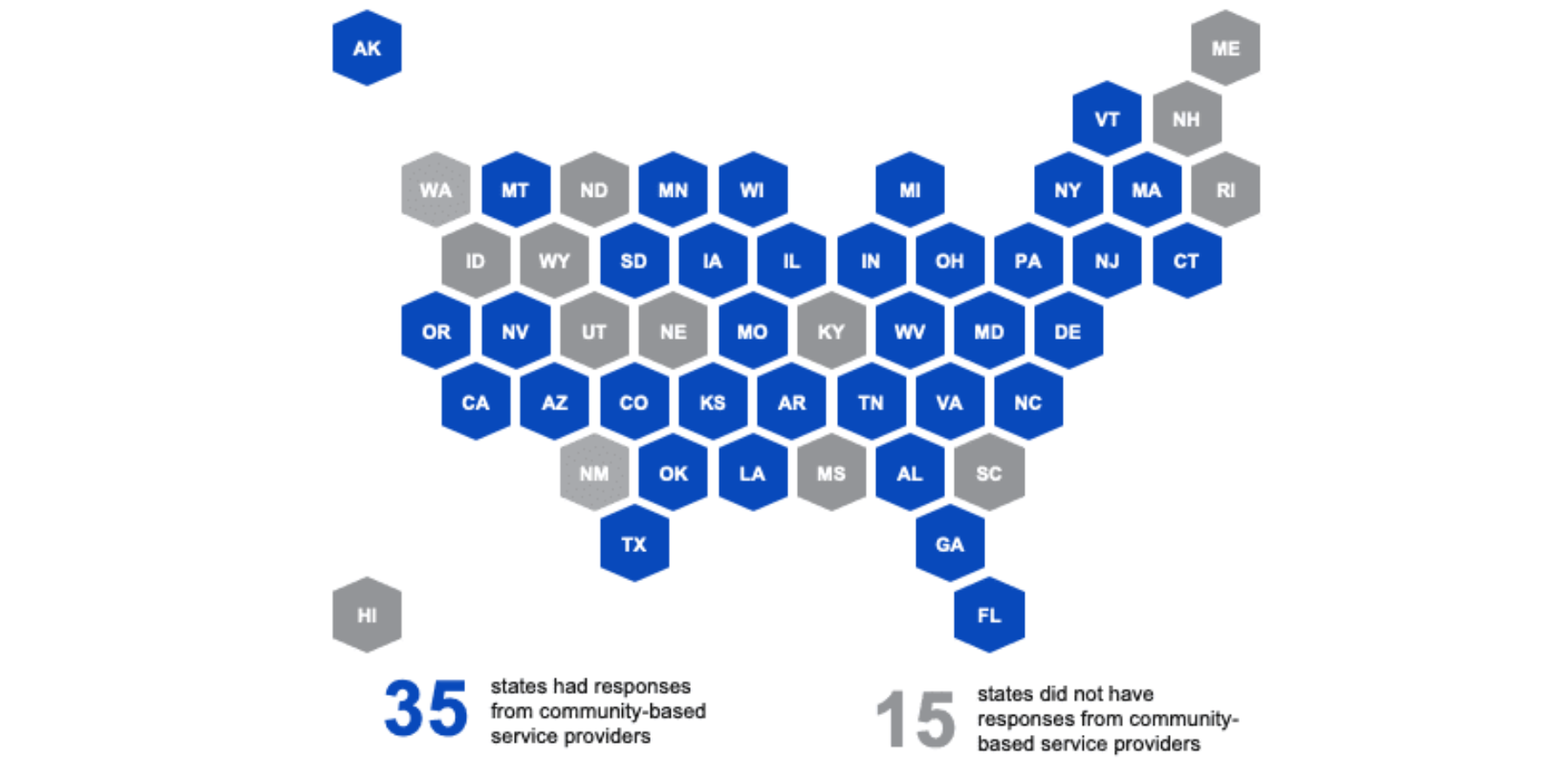
Service providers who participated in the poll hailed from 35 states and serve people in a variety of rural, urban, and suburban areas across the country. Respondents represented a cross-section of entities, ranging from advocacy organizations to homeless service organizations, and provide a variety of services related to reentry, including case-planning, housing, education, mental health, and more.
Despite the diversity of those surveyed, about two-thirds of respondents ranked more funding and resources as their biggest need. Last month, Congress passed a third relief package that included $350 billion in assistance for loans dedicated to small businesses and nonprofits. But the White House reported last week that those funds had recently run dry. The White House and congressional leaders announced Tuesday a deal to expand small business aid as part of a fourth relief bill.
Editor’s Note: For community-service providers seeking financial relief, the CSG Justice Center recently developed a guide to applying for federal and private aid in response to the coronavirus outbreak.
Participating States
Reentry service providers across 35 states participated in the survey, including those reporting from rural, urban, and suburban areas.
"AOT is a complex community intervention that can be effective or not depending on how it is implemented.…
Read More
8 states gathered to discuss workforce solutions for formerly incarcerated people.
Read More
"It is the humane, person-centered approach that supports and stabilizes individuals, their families, and their communities."
Read More
Involuntary Treatment for Patients in the Justice System: Q&A with Dr. Marvin Swartz
"AOT is a complex community intervention that can be effective or not…
Read More
Reentry 2030 States Explore Day 1 Employment Readiness After Incarceration
8 states gathered to discuss workforce solutions for formerly incarcerated people.
Read More
Local Criminal Justice System Innovations in Mental Health Services: Q&A with CSG Justice Center Advisory Board Member Dr. Doreen Williams
"It is the humane, person-centered approach that supports and stabilizes individuals, their…
Read More 2025 Nominations Now Open for Judges and Psychiatrists Improving Lives and Behavioral Health
The Judge Stephen S. Goss Memorial Award for Leadership has expanded to…
Read More Senate Passes Second Chance Reauthorization Act of 2025
On October 9, 2025, the Senate passed the Second Chance Reauthorization Act…
Read More CSG Justice Center Launches First-of-Its-Kind Statewide Crisis Intervention Teams (CIT) Technical Assistance Center
The CSG Justice Center has partnered with the Pennsylvania Commission on Crime…
Read More