






Closer to Home: An Analysis of the State and Local Impact of the Texas Juvenile Justice Reforms
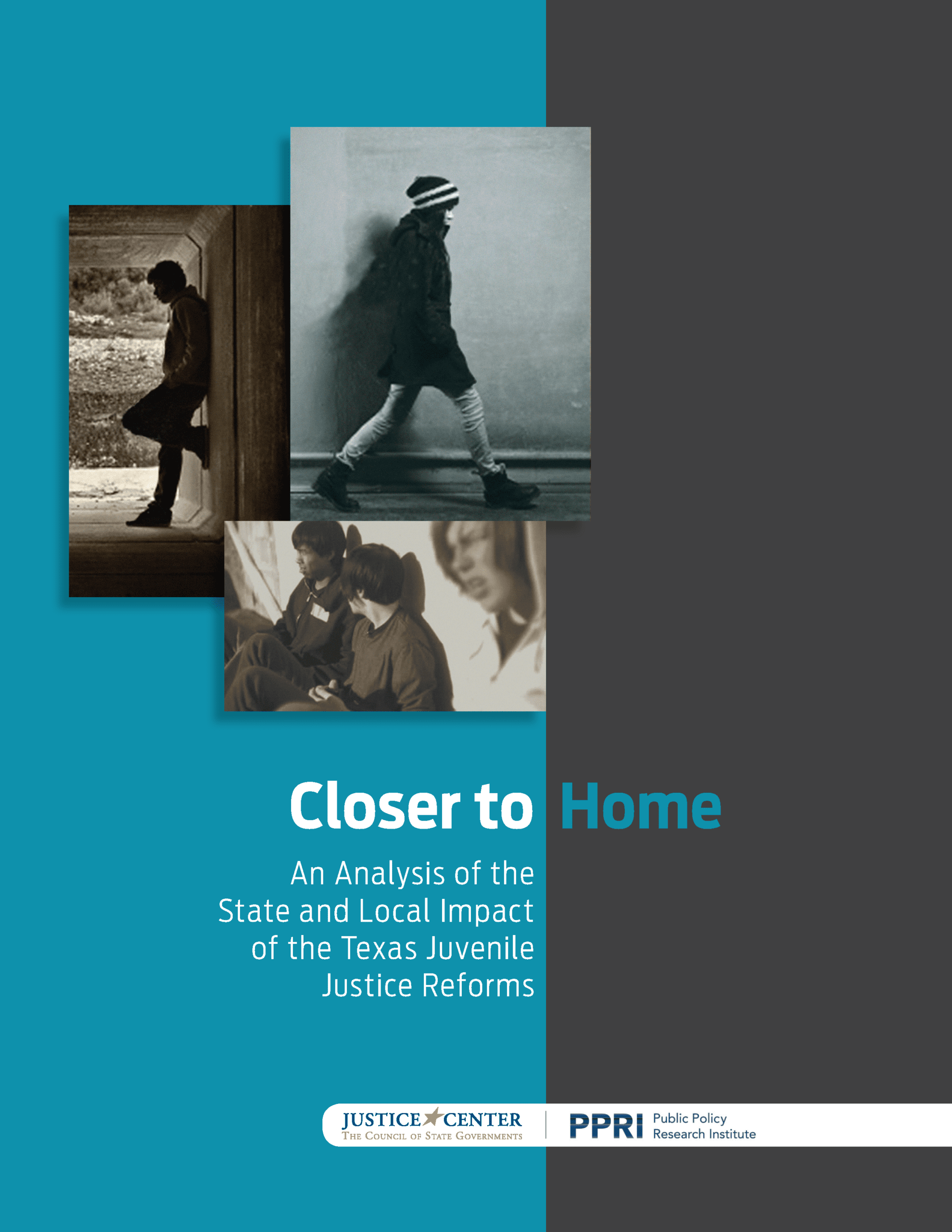
A first-of-its-kind study of Texas youth involved with the juvenile justice system shows that juveniles under community-based supervision are far less likely to reoffend than youth with very similar profiles who are confined in state correctional facilities.
Closer to Home: An Analysis of the State and Local Impact of the Texas Juvenile Justice Reforms, which draws on an unprecedented dataset of 1.3 million individual case records spanning eight years, shows youth incarcerated in state-run facilities are 21 percent more likely to be rearrested than those who remain under supervision closer to home. When they do reoffend, youth released from state-secure facilities are three times more likely to commit a felony than youth under community supervision.
The CSG Justice Center unveiled the report on Thursday, January 29, 2015, in a packed room of the Texas Supreme Court, alongside Tennessee Senate Majority Leader Mark Norris, who also serves as chair of CSG, Texas State Sen. John Whitmire, Texas Chief Justice Nathan Hecht, and a number of others.
“The extraordinary data compiled for this study demonstrates convincingly how much better youth—who prior to the reforms would have been incarcerated—fare instead under community supervision,” said Michael D. Thompson, director of the CSG Justice Center. “It also finds that for those youth placed under community supervision, there is still considerable room for improvement.”
The number of incarcerated youth has decreased by more than 40 percent across the nation—with some state populations declining by as much as 80 percent—since 2000, when the number of juveniles incarcerated was at a record high.in the U.S.

Corrections leaders balance the complex priorities of maintaining public safety, operating secure facilities, providing needed care and services…
Read More
A bipartisan group of 33 members of Congress, lawmakers, led by Congresswomen Carol Miller (R-WV) and Lucy McBath…
Read More
Alabama is taking action to achieve its Reentry 2030 goals and positioning itself as a leader in reentry.
Read More
Apply Now for Resident Analyst Program to Increase Data Analysis Capacity at Departments of Corrections
Corrections leaders balance the complex priorities of maintaining public safety, operating secure facilities, providing needed care and services to the incarcerated population, and coordinating with other agencies.
Read More
Bipartisan Group of 33 Lawmakers Promote Continued Funding for the Justice Reinvestment Initiative
A bipartisan group of 33 members of Congress, lawmakers, led by Congresswomen Carol Miller (R-WV) and Lucy McBath (D-GA), wrote a letter calling for continued funding for the Justice Reinvestment Initiative (JRI) in the Fiscal Year 2026 Commerce, Justice, Science, and Related Agencies Appropriations bill.
Read More
New Alabama Employment Law Advances Reentry 2030 Goals
Alabama is taking action to achieve its Reentry 2030 goals and positioning itself as a leader in reentry.
Read More President’s FY26 Budget Maintains Funding for Key Justice and Behavioral Health Programs Amid Proposed Structural Changes
On May 30, 2025, the White House released the budget request for Fiscal Year (FY) 2026.
Read More Developing a Common Definition for Community Responder Programs
This May, the state of Washington passed legislation supporting the expansion of alternative response teams (sometimes called community responders) as a public safety service.
Read More Finding Solutions to Complex Criminal Justice Issues: Q&A with New CSG Justice Center Advisory Board Member Justice Briana Zamora
The CSG Justice Center Advisory Board establishes the policy and project priorities of the organization. The board features a cross-section of leaders who shape criminal justice policy in various parts of the country.
Read More